Financing and Cybersecurity: A Guide to Effective Protection
In an increasingly digital economy, the connection between finance and cybersecurity has never been more critical. Cyber threats continue to grow in scale and sophistication, exposing financial institutions, businesses, and public organizations to unprecedented risks. Understanding how these threats evolve is essential before exploring how cybersecurity initiatives can be funded. Recent analyses of the state of cybersecurity in French companies highlight the severity of the challenge, reinforcing the need for well-structured and adequately financed protection strategies. In this context, identifying the right funding approaches becomes a decisive step for any organization aiming to strengthen its security posture.

.png)
Finance and cybersecurity: The current state of cybersecurity
Understanding today’s threat landscape
The financial sector operates in one of the world’s most hostile cyber threat environments. Attackers are increasingly organized, well-funded, and motivated by the high value of financial data and transactions. Ransomware campaigns, social engineering attacks, identity theft, and supply-chain compromises now target not only global financial institutions but also SMEs, fintech companies and third-party vendors.
According to recent global industry reports, cyberattacks on financial firms occur 300 times more frequently than in other sectors. This disproportionate exposure confirms that financial systems remain prime targets due to their access to sensitive information, liquidity, and interconnected infrastructures.
Key statistics illustrating the cybersecurity challenge
The rise in cyber incidents is not a temporary trend but a structural shift. Industry studies show:
· Over 60% of financial institutions experienced at least one significant cyber incident in the past 12 months.
· Ransomware remains one of the fastest-growing threats, with the average cost of recovery surpassing several million euros per incident.
· Third-party risk is a major weakness: more than 50% of breaches in the financial sector originate from external vendors.
· The financial industry is now one of the most regulated in terms of data security and business continuity, yet breaches continue to rise.
These figures illustrate the complexity of protecting modern financial ecosystems, where cloud systems, APIs and digital customer services multiply points of exposure.
Why cybersecurity matters for businesses and individuals
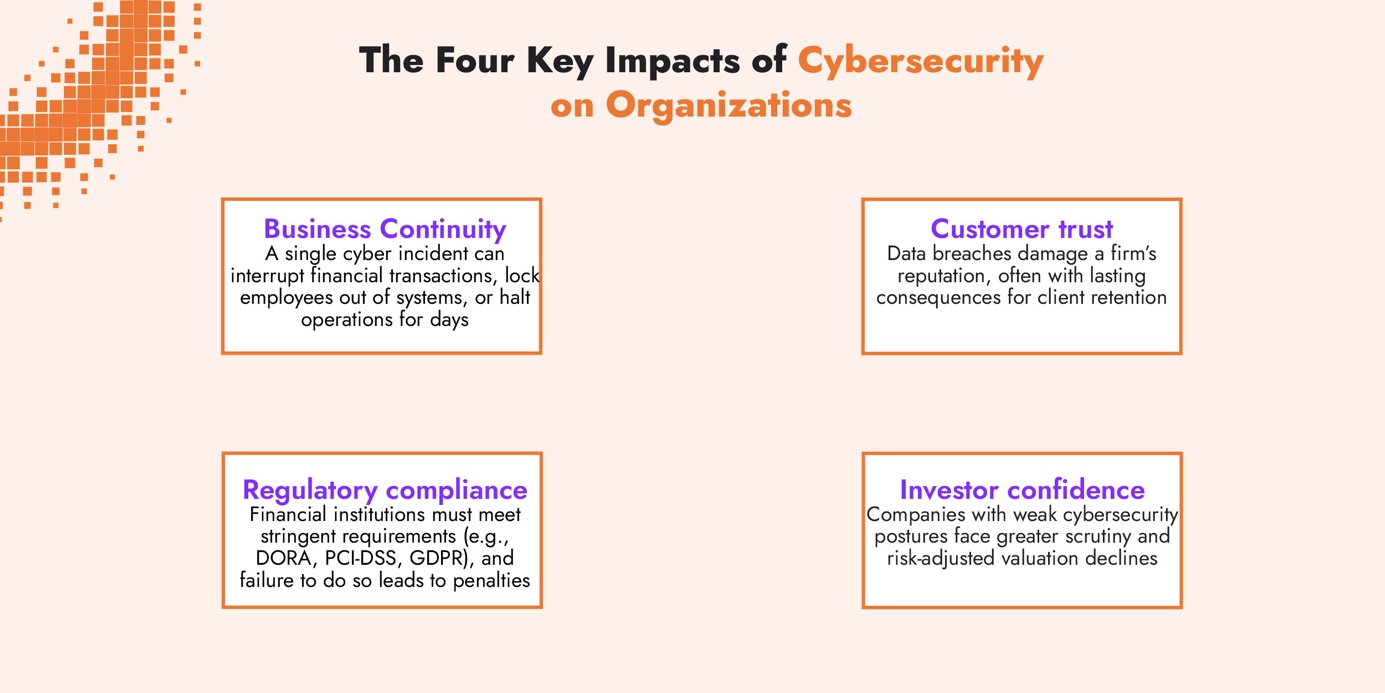
Cybersecurity is no longer a technical concern reserved for IT departments. It directly impacts:
· Business continuity: a single cyber incident can interrupt financial transactions, lock employees out of systems, or halt operations for days.
· Customer trust: data breaches damage a firm’s reputation, often with lasting consequences for client retention.
· Regulatory compliance: financial institutions must meet stringent requirements (e.g., DORA, PCI-DSS, GDPR), and failure to do so leads to penalties.
· Investor confidence: companies with weak cybersecurity postures face greater scrutiny and risk-adjusted valuation declines.
For individuals, financial cybercrime leads to identity theft, fraudulent transactions, and loss of personal data, issues that can take years to resolve.
The protection gap: why financing matters
Despite the growing threat, many organizations still underinvest in cybersecurity. The gap between the sophistication of attackers and the resources allocated to defense widens each year. Even large institutions struggle to maintain adequate funding for:
- Modern security tools
- Skilled cybersecurity professionals
- Continuous monitoring and incident response
- Resilience planning and recovery capabilities
This gap makes it essential to build strategic, well-structured financing models capable of sustaining long-term cyber resilience.
Why is funding crucial in cybersecurity?
Cybersecurity resilience depends on sustained and well-structured investment. Threats evolve quickly, regulatory requirements intensify, and infrastructures become more complex each year. In this context, adequate funding is not optional: it is the foundation that enables organizations to build, maintain and adapt their security capabilities. Three areas, in particular, require consistent financial commitment.
Human resources: expertise, training and retention
Cybersecurity remains a people-driven discipline. Even the most advanced tools provide limited protection without qualified professionals to configure, monitor and improve them. Funding is therefore essential to attract and retain specialized profiles - analysts, detection engineers, incident responders, cloud security experts and governance leaders.
Investment must also support continuous training. Threats evolve faster than traditional skill cycles, making upskilling crucial for maintaining operational effectiveness. Organizations that underfund human capital often find themselves operating in reactive mode, unable to anticipate emerging risks or respond effectively to incidents.
Salaries, professional development and internal career paths are not ancillary costs: they are strategic levers for building long-term cybersecurity maturity.
Tools and technology: building a modern and adaptive security infrastructure
Beyond people, technology constitutes the second major pillar of cybersecurity investment. Security infrastructures degrade quickly when funding does not keep pace with evolving threats or architectural changes. Modern environments - hybrid cloud, remote work, interconnected suppliers - require tools capable of monitoring, analyzing and protecting a growing volume of activity.
Funding supports the acquisition and maintenance of essential technologies such as advanced monitoring platforms, identity and access management systems, endpoint protection solutions and data security controls. These tools must be updated regularly and integrated properly within the organization’s risk management framework.
Underinvestment in technology often results in blind spots, outdated systems and ineffective detection capabilities, all of which increase exposure to cyber incidents.
Research and development: strengthening long-term resilience
Cybersecurity is not a static discipline. Organizations must continuously refine their defences to remain resilient in the face of new attack techniques and regulatory expectations. Funding dedicated to research and development enables proactive security rather than reactive response.
This includes testing new security models, conducting simulation exercises, analyzing threat intelligence, and investing in innovation. These activities may not deliver immediate returns but are essential for identifying vulnerabilities early and strengthening the organisation’s long-term defensive posture.
Without sustained R&D investment, security strategies stagnate while attackers evolve, creating a widening gap between threat capabilities and defensive measures.
Sources of finance for cybersecurity
Financing cybersecurity requires a combination of internal and external resources. As threats grow in sophistication and regulatory expectations increase, organizations must adopt diversified funding strategies to support both immediate needs and long-term resilience. Three primary sources of financing play a central role: internal budgets, government initiatives, and private investment.
Internal funding: the foundation of cybersecurity investment
For most organizations, internal budgets remain the main and most flexible source of financing. These funds support operational security, technology maintenance, staffing and incident response capabilities. Internal financing has the advantage of aligning directly with organizational priorities and risk appetite, making it possible to respond quickly when new threats emerge or when systems require upgrades.
However, internal budgets are often subject to competing priorities. When cybersecurity is treated as a short-term operational cost rather than a multi-year strategic commitment, funding may fluctuate from one cycle to another. This variability can hinder long-term planning, delay essential improvements, or leave the organization exposed during periods of reduced investment.
A well-structured internal financing model should therefore include stable, recurring allocations designed to support both daily operations and long-term strategic initiatives.
Government grants and public support programs
In many regions, public authorities recognize the strategic importance of cybersecurity - especially in sectors handling sensitive data and financial transactions. To encourage stronger protective measures, governments provide grants, subsidies and co-funded programs aimed at improving digital resilience.
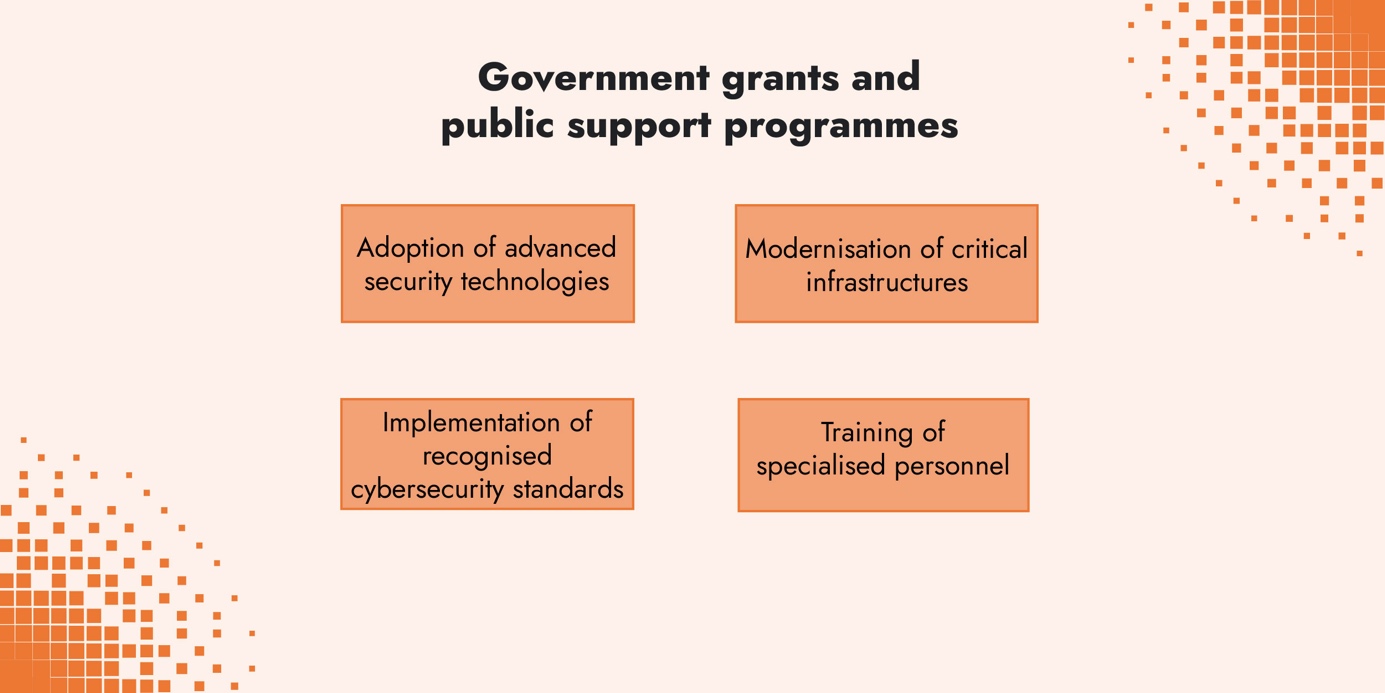
These initiatives typically support:
- The adoption of advanced security technologies
- The modernization of critical infrastructures
- The implementation of recognized cybersecurity standards
- The training of specialized personnel
Government funding can significantly reduce the financial burden of major projects, particularly for mid-sized organizations that may lack the resources to invest at scale. While application processes require planning and documentation, the long-term benefits often outweigh the administrative effort. For organizations operating in regulated industries such as financial services, public subsidies can help align internal financing with compliance requirements.
Investors and venture capital: accelerating innovation and market readiness
For companies that develop cybersecurity products or services, external investment -especially venture capital - plays a decisive role. Cybersecurity is now considered a high-growth sector, attracting investors who recognize both its economic potential and its importance for national resilience. As a result, startups and scale-ups benefit from funding that enables them to accelerate research, expand product capabilities and enter new markets.
Beyond financing product development, investor engagement strengthens the broader ecosystem by fostering innovation and competition. Organzsations seeking advanced security solutions benefit from this dynamic, as new tools and services emerge more rapidly, offering improved efficiency and better alignment with evolving threats.
Venture funding also supports collaboration between established organizations and emerging technology providers. These partnerships help enterprises modernize their security posture more quickly than if they relied solely on internal resources.
Challenges and barriers of finance cybersecurity
Financing cybersecurity is not simply a budgeting exercise. Organizations face several obstacles that make it difficult to allocate, justify and optimize the resources required to build effective security capabilities. These challenges are particularly pronounced in the financial sector, where exposure to cyber risk is high and regulatory expectations are increasingly demanding.
Understanding and demonstrating Return on Investment (ROI)
Unlike traditional IT or business initiatives, cybersecurity investment does not always produce visible or immediate outcomes. Its primary value lies in preventing incidents, events that may never occur or whose probability is difficult to quantify. This makes cybersecurity ROI inherently complex.
Leadership teams often request metrics to justify additional funding, yet many security benefits are indirect: reduced downtime, lower regulatory exposure, preserved reputation, or improved customer trust.
Without clear indicators, some organizations hesitate to allocate significant budgets, even though the cost of a major incident far exceeds the investment required to prevent it.
The challenge, therefore, is to define ROI in terms of risk reduction rather than revenue generation.
Justifying budgets to senior management and boards
Cybersecurity leaders must translate technical risk into strategic language that resonates with executive committees and boards. This requires explaining:
- how specific threats impact business operations,
- which vulnerabilities carry the greatest potential financial cost,
- why certain investments must take priority over others.
However, cybersecurity is often perceived as a specialized area outside the traditional scope of financial decision-makers. Without effective communication, funding requests may appear abstract or disproportionate, leading to underinvestment.
Clear governance models and risk-based reporting frameworks help bridge this gap, ensuring that cybersecurity budgets align with organizational priorities.
Regulatory pressure and its impact on financing
The financial sector is subject to an expanding set of regulations and standards: GDPR, PCI-DSS, DORA, ISO 27001 and more. Each framework introduces new obligations around data protection, monitoring, reporting and operational resilience.
Meeting these requirements requires significant investment in tools, processes and personnel. While regulations strengthen overall security, they also increase financial pressure on organizations that must balance compliance costs with broader transformation initiatives.
For some institutions, regulatory-driven investment consumes a large portion of the cybersecurity budget, leaving fewer resources available for innovation or proactive risk reduction.
Competition for resources within the organization
Cybersecurity does not exist in isolation. IT transformation, cloud migration, digital product innovation and operational efficiency initiatives also compete for financial resources.
In environments where budgets are limited, cybersecurity may be deprioritized in favor of projects perceived as revenue-generating or customer-facing.
This competition is particularly challenging because many cybersecurity needs are non-negotiable. Delaying an upgrade or reducing staffing may create vulnerabilities that attackers can exploit. Organizations must therefore balance short-term financial constraints with the long-term cost of potential incidents.
Organizational complexity and third-party environments
Modern financial systems rely heavily on third-party providers, from cloud platforms to payment processors and software vendors. Securing these distributed environments requires investment in monitoring, contractual controls, and vendor risk assessments.
Yet organizations often underestimate the resources needed to evaluate and manage third-party risk. Underfunded oversight leads to blind spots—some of the most common and most costly sources of breaches.
How to plan the financing of your cybersecurity?
Effective cybersecurity financing requires more than allocating a fixed annual budget. It involves structuring investments around risk, business priorities and long-term resilience. Organizations that take a strategic approach are better equipped to respond to emerging threats, comply with evolving regulations and maintain operational continuity. Three steps are particularly important when building a sustainable cybersecurity financing plan.
Establishing a structured cybersecurity budget
A cybersecurity budget should be based on a clear understanding of the organization’s digital assets, threat exposure and regulatory obligations. This requires close collaboration between security teams, finance departments and senior leadership.
The budgeting process should distinguish between recurring operational expense, such as monitoring, patching or staff training, and strategic investments, including infrastructure modernisation or major technology upgrades.
A multi-year approach is essential. It ensures that long-term initiatives, such as identity management programs or cloud security transformations, receive consistent funding rather than being disrupted by annual budget cycles.
Organizations that build their budgets around risk assessments rather than fixed percentages of IT spending gain better alignment between protective measures and actual exposure.
Evaluating Return on Investment (ROI) from a risk-reduction perspective
Traditional ROI models do not apply neatly to cybersecurity. The value of an investment often lies in the incidents that do not occur. For this reason, organizations need metrics that quantify improvement in terms of risk reduction, not direct financial gains.
This may include reduced incident response times, improved detection coverage, higher compliance scores, or decreased dependency on vulnerable legacy systems.
These indicators help demonstrate the effectiveness of the cybersecurity programme and justify sustained investment to executive management and the board.
Over time, a clear and consistent method for evaluating ROI strengthens decision-making and supports transparent communication across the organization.
Conclusion
Financing cybersecurity is now a strategic imperative. As threats evolve and regulatory expectations intensify, organizations must establish stable, long-term investment models that support both operational security and structural resilience. Effective funding enables teams to attract expertise, modernize technology, strengthen governance and anticipate emerging risks. For organizations in the financial sector and beyond, building a mature financial strategy for cybersecurity is not only a defense measure : it is an essential driver of trust, continuity and competitiveness in a digital-first economy.
How much should organizations invest in cybersecurity?
There is no universal benchmark, as effective investment depends on an organization’s size, risk exposure and regulatory environment. However, budgets are most efficient when they are based on risk assessments rather than fixed percentages of IT spending. This approach ensures that resources align with the organization’s actual security needs.
What factors influence the cost of a cybersecurity program?
The main cost drivers include staffing needs, technology renewal cycles, regulatory obligations, and the complexity of third-party environments. Organizations with ageing infrastructures or highly interconnected systems typically require more significant investment to maintain an adequate level of protection.
How can organizations measure the effectiveness of cybersecurity spending?
Cybersecurity ROI is best assessed through risk reduction metrics such as improved detection rates, faster incident response, enhanced compliance levels or reduced exposure to legacy vulnerabilities. These indicators help demonstrate program efficiency and support informed funding decisions.
Related articles
Read more on cyber risk, ransomware attacks, regulatory compliance and cybersecurity.
.svg)
.png)

.png)