Cybersecurity Compliance: Going Beyond the Checklist
Cybersecurity compliance is creating real tension for many organizations. Regulatory requirements keep expanding, but the time and effort spent on compliance alone doesn’t necessarily translate into better security or resilience. When compliance is a checklist exercise, you are left with fragmented controls and limited insight into which risks actually matter.
This article looks at how you can move beyond that model. It shows how cybersecurity compliance as part of a data-driven risk management program supports risk-based decision-making, operational resilience, and business objectives. By linking regulatory requirements to risk and financial impact, you can make compliance efforts more effective and more relevant to the business.
- Cyber regulations are expanding in scope, increasing accountability for executives and boards
- Treating compliance as a checklist drives cost with limited impact on reducing cyber risk
- New regulations (NIS2, DORA, SEC rules) explicitly link security, governance, and operational resilience
- CISOs are under pressure to explain compliance decisions in financial and business terms
- Organizations that adopt risk-based, data-driven compliance are better positioned to scale and adapt as regulations evolve
The Cybersecurity Regulatory Landscape: Understanding the Strategic Challenges
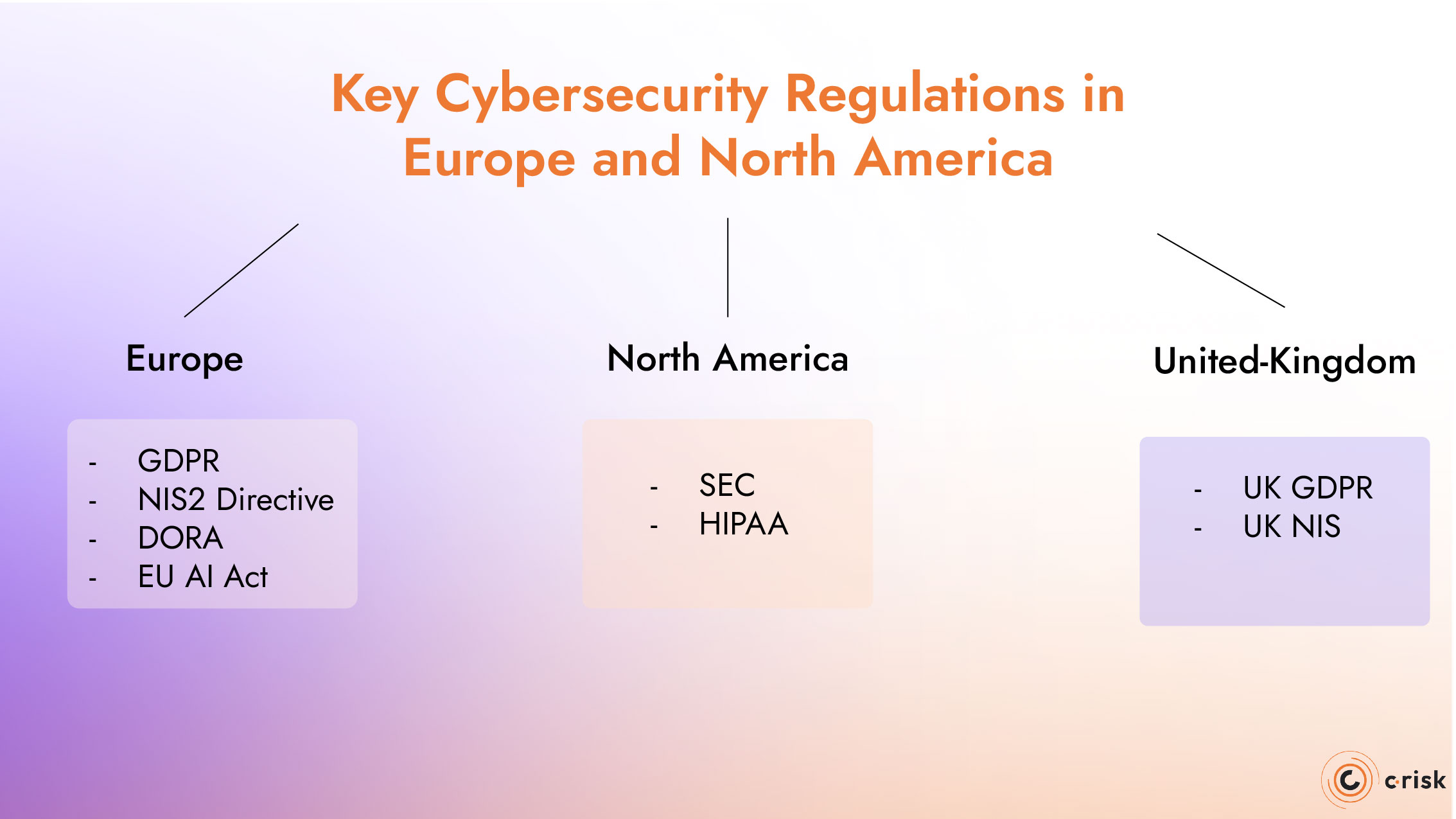
Key Cybersecurity Regulations in Europe and North America
The reach of today’s cybersecurity regulatory landscape is undergoing some big changes. And depending on the geography where you operate, you could be facing a number of cybersecurity compliance challenges, obligations, each with distinct scope, governance, and reporting requirements. The US, the UK and the European Union are all navigating this landscape with their own regulations and legislation.
Key Cybersecurity Regulations in Europe
GDPR — General Data Protection Regulation
- Scope: Applies to organizations that process personal data of individuals in the European Union, regardless of where the organization is established.
- Compliance obligations: Regulated entities must implement appropriate technical and organizational measures to protect personal data, ensure lawful processing, maintain records of data processing, and notify supervisory authorities of qualifying data breaches within prescribed timeframes.
NIS2 Directive – Network and Information Security Directive
- Scope: Applies to essential and important entities across a broad range of sectors, including critical infrastructure, digital services, and key industrial domains.
- Compliance obligations:
Regulated entities must adopt risk management measures for network and information systems, implement incident detection and reporting capabilities, address supply-chain and third-party risks, and establish governance arrangements involving senior management.
DORA — Digital Operational Resilience Act
- Scope: Applies to financial entities and certain ICT third-party service providers supporting the financial sector.
- Compliance obligations: Regulated entities must establish an ICT risk management framework, conduct resilience testing, report major ICT-related incidents, manage ICT third-party risk, and maintain operational continuity.
- Timeline: Entered into force in January 2023 and has been applicable since January 2025.
EU AI Act
- Scope: Applies to providers and users of AI systems placed on or used within the EU market.
- Compliance obligations: Depending on risk classification, regulated entities must implement governance controls, risk management processes, technical documentation, human oversight mechanisms, and post-market monitoring.
Key Cybersecurity Regulations in the UK
UK GDPR
- Scope: Applies to organizations that process personal data of individuals in the European Union, regardless of where the organization is established.
- Compliance obligations: Regulated entities must implement appropriate technical and organizational measures to protect personal data, ensure lawful processing, maintain records of data processing, and notify supervisory authorities of qualifying data breaches within prescribed timeframes.
UK NIS
- Scope: Applies to operators of essential services and digital service providers in the United Kingdom.
- Compliance obligations: Regulated entities must implement appropriate security measures, manage operational risks, and notify competent authorities of significant cybersecurity incidents.
Key Cybersecurity Regulations in the US
SEC Cybersecurity Disclosure Rules
- Scope: Applies to publicly listed companies subject to US securities regulation.
- Compliance obligations: Regulated entities must disclose material cybersecurity incidents and provide transparency on cyber risk management, governance, and oversight arrangements through 8-K and 10-K disclosures.
HIPAA – Health Insurance Portability and Accountability Act
- Scope: Applies to covered entities and business associates handling protected health information (PHI).
- Compliance obligations: Regulated entities must implement administrative, technical, and physical safeguards to protect electronic PHI and maintain breach notification processes.
The Evolution of the Regulatory Landscape: Anticipating Change
Compliance should be the baseline of your cybersecurity risk management program. Regulatory requirements are always evolving in response to digital transformation, cloud adoption, supply-chain dependencies, and emerging threats such as ransomware and outages. They are also dependent on the international and national political climate.
Organizations that treat compliance as their risk management checklist struggle to keep pace with these changes. In contrast, CISOs who adopt risk-based, data-driven cyber risk management will be perennially better positioned to adapt as regulations change. Rather than reacting regulation by regulation, a data-driven risk management program builds scalable capabilities that support multiple frameworks, focusing on protecting critical assets and processes.
From Reactive Cybersecurity Compliance to Strategic Compliance
Moving Beyond the Traditional Defensive Approach
In many organizations, cybersecurity compliance is still achieved through a reactive risk management approach. Risk assessments and control assessments are triggered by audits or regulatory deadlines. This approach is more common within less mature cyber risk management programs. And it often positions compliance as the objective rather than as a driver of secure growth.
A strategic compliance approach shifts the focus from reactive risk identification and management to risk-informed decision-making. Controls are designed around outcomes: protecting critical assets, maintaining service continuity, and enabling the business to scale securely. Instead of reacting regulation by regulation, organizations invest in capabilities that manage risk while supporting growth across multiple regulatory frameworks.
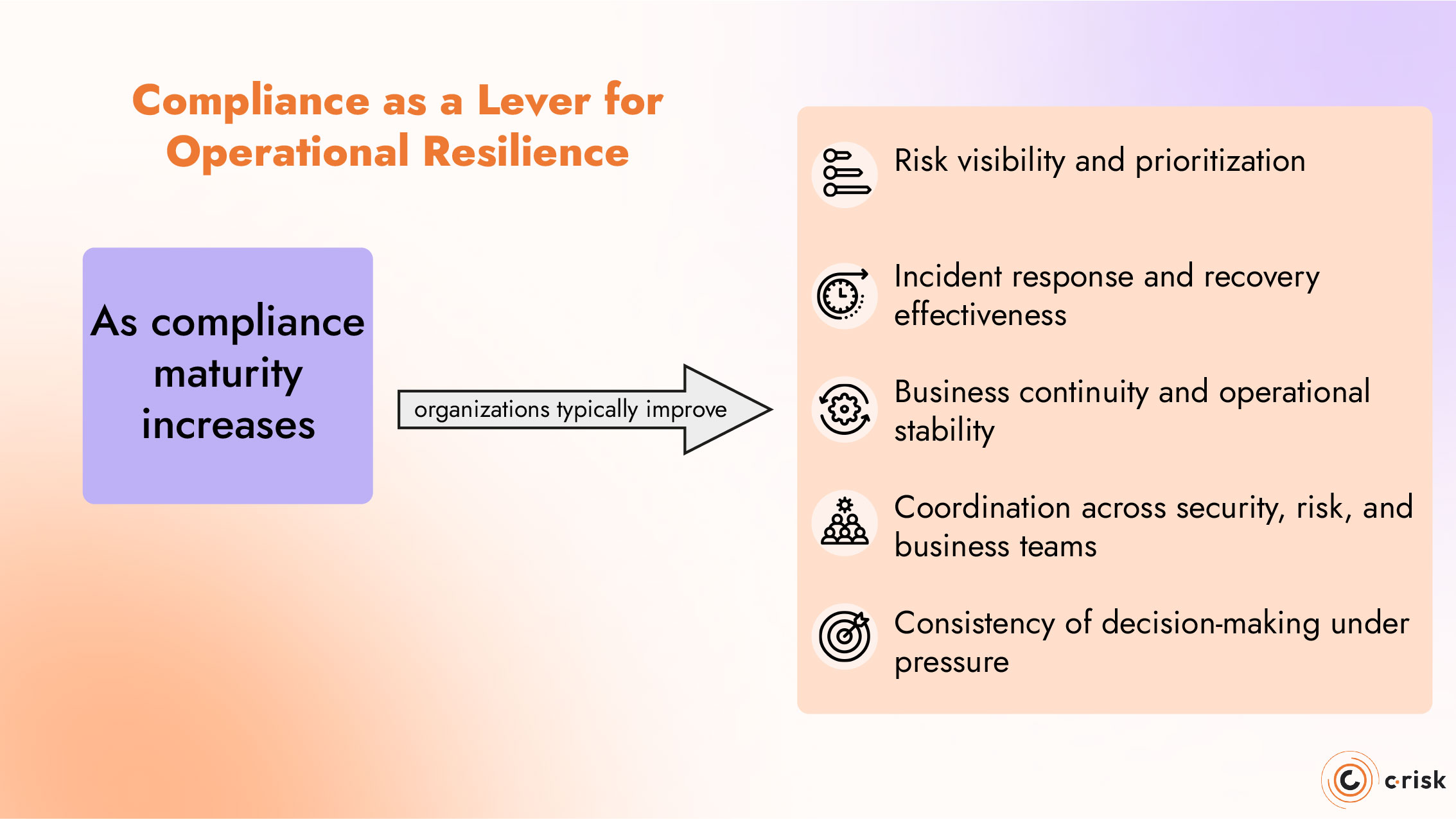
Compliance as a Lever for Operational Resilience
Cyber security compliance maturity is closely linked to operational resilience when regulatory requirements are embedded into risk management and business continuity practices. Regulations such as NIS2 and DORA explicitly connect security controls, incident management, and continuity planning, reinforcing the idea that compliance is a structural component resilience.
As compliance maturity increases, organizations typically improve:
- Risk visibility and prioritization
- Incident response and recovery effectiveness
- Business continuity and operational stability
- Coordination across security, risk, and business teams
- Consistency of decision-making under pressure
The Case for Quantifying Compliance Risk
Measuring the Financial Impact of Cyber and Technology Risk
Traditional compliance assessments describe gaps but don’t address the financial impact of their consequences. Quantitative risk methods make it possible to measure the impact of cyber and technology risk in financial terms, enabling comparison with other enterprise risks and investment decisions. The FAIR™ (Factor Analysis of Information Risk) framework can also be applied to compliance risk scenarios by modeling the frequency and magnitude of regulatory fines or judgements.
Data-Driven Prioritization of Compliance Actions
Most organizations assess compliance risk through:
- Gap assessments against regulations or standards
- Control maturity scoring (low / medium / high)
- Audit findings and remediation tracking
This answers the question: Are we compliant?
These assessments, maturity scores and audit findings, however, don’t allow you to answer the question: What happens financially or operationally if we are not?
To address this gap, organizations can optimize resource allocation using quantitative analysis. By expressing compliance risk in financial terms, decision-makers gain a consistent basis for prioritization across different regulations, initiatives, and business units.
Cyber risk quantification (CRQ) provides a reasoned structure for this analysis. Compliance initiatives can be evaluated based on their implementation cost, the amount of risk exposure they reduce. This makes it possible to distinguish between actions that improve audit posture and those that materially reduce financial or operational risk.
When multiple remediation options compete for limited resources, organizations can compare them using a common metric: how much risk is reduced in financial terms. Controls that reduce exposure across multiple regulatory requirements or high-impact scenarios can be prioritized over low-impact initiatives.
Instead of addressing compliance regulation by regulation, you can prioritize initiatives and align compliance actions with business priorities and risk appetite.
Building a Risk-Based Compliance Program
Integrating Compliance into the Overall Business Strategy
When cybersecurity compliance is treated holistically it builds value for the enterprise. In practice, this means:
- Embedding cybersecurity into Enterprise Risk Management (ERM) governance processes
- Operationalizing risk assessments, controls and audits
- Presenting cybersecurity risk in business terms, linked to strategy, digital initiatives, and resilience
- Using business-oriented KPIs to support executive decision-making
- Strengthening your third-party risk management
Operationalizing Risk-Based Cybersecurity Compliance
Moving to risk-based cybersecurity compliance requires more than alignment at the strategy level. It depends on whether risk assessments, control evaluations, audits, and remediation decisions can be executed in a consistent and repeatable way.
When communication and information-sharing are siloed across assessments, spreadsheets, and disconnected tools, it becomes difficult to compare risks, prioritize actions, or clearly explain decisions to regulators and executives. Operationalizing risk-based compliance means establishing common methods and governance, supported by appropriate tooling—such as cyber risk quantification solutions—to connect regulatory requirements to risk scenarios and business impact. This enables security, risk, and business teams to work from a shared view of exposure.
How C-Risk Helps Organizations Put Risk-Based Cybersecurity Compliance into Practice
Turning a risk-based cybersecurity compliance strategy into day-to--day execution is a real challenge. At C-Risk, we help risk and security teams bring effective communication and momentum to their cyber risk management programs. Our experts help you move beyond compliance as a checklist exercise and toward compliance as springboard for bringing value to the business.
C-Risk works with your teams to:
- Define shared risk language and governance that aligns security, risk, legal and business stakeholders
- Map regulatory requirements to real risk scenarios and business impact, so decisions are grounded in context
- Apply quantitative methods (e.g., FAIR-based cyber risk quantification) to express compliance exposure in business and financial terms
- Prioritize remediation and risk reduction actions based on risk exposure and business priorities
- Improve reporting to executives and regulators with clear, defensible risk narratives
Whether you are standing up a risk-based compliance operating model for the first time or enhancing one you already have, we can help you bridge strategy and execution with practical methods, governance frameworks, and measurable outcomes.