Third-Party Cyber Risk Management: A comprehensive guide to managing your extended enterprise
An organization’s cybersecurity posture is as strong as their weakest third-party. Many organizations reduce third-party risk management to audits and checklists. Yet in an extended ecosystem with strategic partners, resilience demands continuous monitoring, clear risk governance, and measurable oversight. In this article, we explain what third-party cyber risk management is and how to strengthen your supply chain security with a data-driven, business-aligned approach.
- Third-party cyber risk has become a strategic enterprise risk, not just a compliance concern.
- Regulations such as DORA and NIS2 require board oversight, accountability, and resilience across the supply chain.
- As ecosystems grow more complex, evidence-based and technology-driven oversight allows organizations to move from reactive assessments to proactive, continuous third-party resilience.
- Quantitative models like FAIR™ translate third-party risk into financial terms, enabling informed decision-making.
- Building a mature TPRM program means integrating governance, automation and measurable risk reduction into enterprise resilience.
Critical issues for Third-Party Cyber Risk Management
In today’s interconnected digital economy, your network of third parties reaches far beyond your organization’s direct control. Each cloud service, SaaS provider, and partner represents a potential vulnerability. Recent studies show that nearly one in three data breaches originate from a third-party vector, and most involve software or technology providers. With organizations now relying on hundreds, and sometimes thousands, of vendors, the digital supply chain has become a critical source of exposure and a growing concern for boards and regulators.
Frameworks such as the G7’s Fundamental Elements for Third-Party Cyber Risk Management and the EU’s Digital Operational Resilience Act call for stronger governance, continuous monitoring, and visibility across the ICT supply chain. However, traditional compliance-based approaches to third-party risk management that rely on point-in-time questionnaires, and ad hoc audits are not enough. At C-Risk, we advocate for large organizations to adopt a data-driven, quantitative model that translates supplier cyber exposure into financial terms, helping to prioritize actions, allocate budgets, and strengthen resilience across their entire ecosystem.
The explosion of cyber risks in the extended enterprise
Understanding third-party risk is integral to any information security strategy. According to one 2024 cyber insurance survey, 40% of breach claims reported by insurers involved a third party. And by 2023, 98% of organizations had at least one third party in their network that had already suffered a breach. The 2023 MOVEit incident further underscored how attacks on vendor systems can ripple outward, affecting clients not directly targeted.
Most third parties also have third and fourth parties, meaning vulnerabilities can propagate in unexpected ways. McKinsey warns that organizations must manage not only third parties but also those several layers removed, “Modern technology supply chains are not much like chains at all. In fact, they are more like three-dimensional spiderwebs, each strand of which is connected to and dependent on others, and some of which are far removed from the company itself.”
Similarly, the World Economic Forum identifies supply chain interdependencies as a leading factor in cybersecurity complexity, noting that many organizations struggle to maintain visibility across multi-tier supplier networks.
Regulatory expectations evolve to address systemic third-party challenges
To address the growing interdependencies within the extended enterprise, regulators and international bodies have introduced new frameworks and guidance that formalize expectations for third-party and ICT supply chain risk management. The EU’s Digital Operational Resilience Act (DORA), the NIS2 Directive, the G7 Fundamental Elements for Third-Party Cyber Risk Management, and the U.S. Interagency Guidance on Third-Party Relationships: Risk Management all share a common goal: to strengthen governance, ensure continuous oversight, and enhance operational resilience across complex third-party ecosystems.
These initiatives collectively emphasize that third-party cyber risk management must be proactive, continuous, and integrated into enterprise governance:
- Continuous monitoring and resilience by design: DORA and NIS2 require continuous oversight of ICT and third-party providers.
- Integration into governance frameworks: Boards and senior management must maintain accountability for third-party resilience.
- Dynamic risk management: Both regulations call for reassessing suppliers when circumstances change.
- Systemic awareness: Both DORA and the G7 fundamental elements emphasize monitoring for concentration and systemic risks across shared suppliers.
- Collaboration and information sharing: Entities are encouraged to coordinate incident response and share threat intelligence with peers, regulators, and suppliers.
Across these frameworks, a common theme has clearly emerged. Regulators are moving away from point-in-time compliance toward continuous, risk-based oversight of third parties. However, for many organizations, translating these principles into measurable, actionable programs remains a challenge.
Building a risk-based methodology for third-party cyber risk
Mapping and classifying your third-party ecosystem
Mapping third partiesto valuable assets supporting value chains
Does your third party have accessto:
o critical IT system components
o key data assets
o revenue generating processes
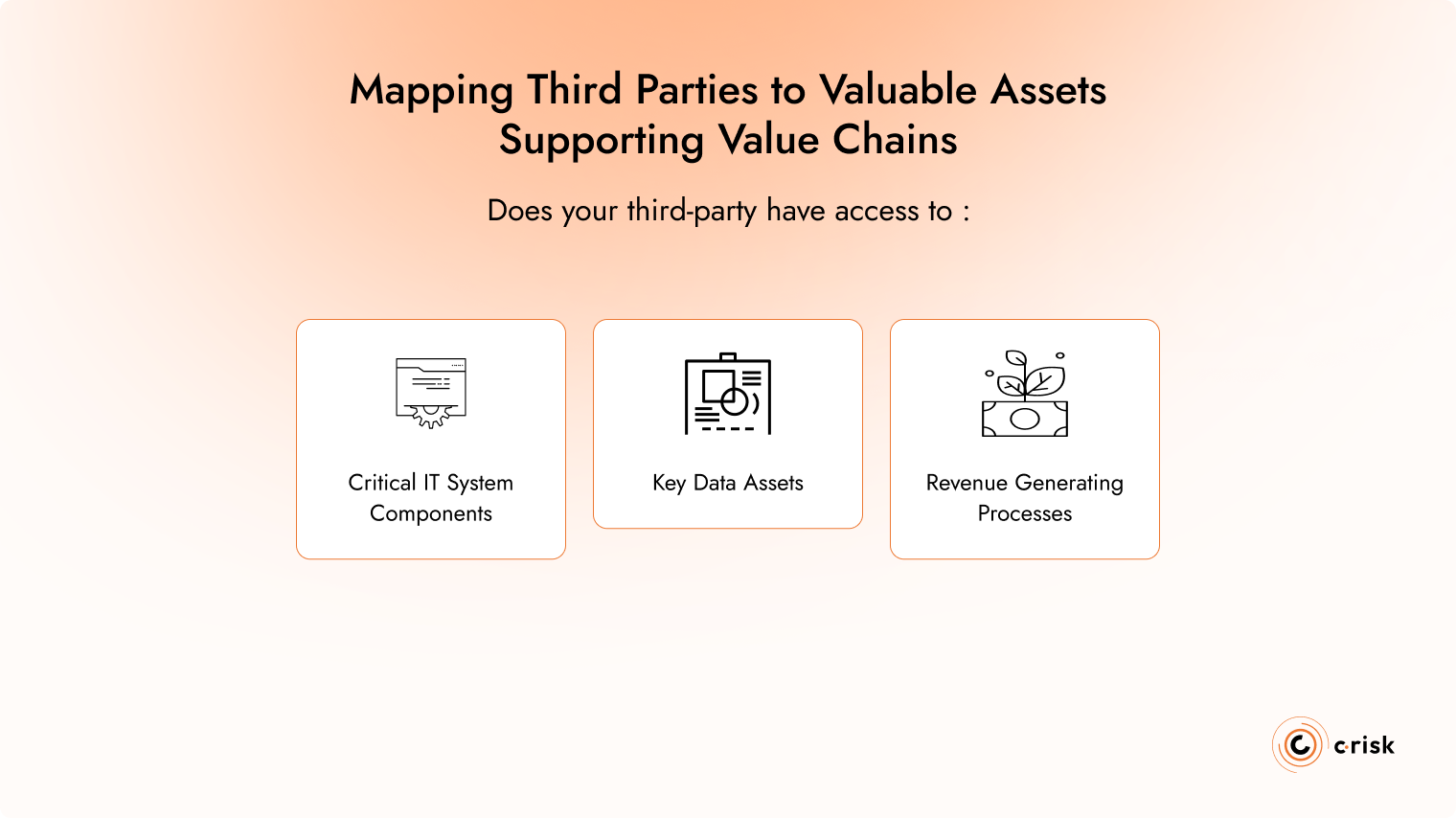
A risk-based approach begins with gaining visibility into all third parties and establishing a holistic methodology across your third-party landscape. Many organizations operate with fragmented supplier data that is scattered across procurement, IT, and business functions, making it difficult to understand the critical dependencies and interdependencies. Moreover, the absence of a unified third-party risk management methodology results in duplicated efforts as well as gaps in oversight and prioritization.
The first objective is to consolidate a unified, dynamic inventory of all third parties across the enterprise. This inventory should link each third party to the business assets, data, and processes they have access to. By aligning supplier information with business impact and information flows, organizations can establish the first level of triage, identifying which relationships warrant deeper assessment and continuous monitoring.
Quantitative risk assessments for data-driven prioritization
Once third parties are mapped and classified, organizations need a consistent way to evaluate how much risk each relationship represents. Today, this is where many programs stall: fragmented taxonomies and scoring models across procurement, IT security, and business functions make supplier assessments difficult to compare or aggregate. A quantitative approach addresses this by introducing financial measurement into third-party risk assessment. By linking each supplier’s role, access to crown jewels, and dependency level to loss scenarios, organizations can estimate the financial exposure associated with potential a breach or disruption. This enables a data-driven view of risk across the ecosystem to support prioritization, budget allocation, and board-level reporting.
Taking a FAIR approach to TPRM
Frameworks such as FAIR (Factor Analysis of Information Risk) make this quantification practical by decomposing third-party risk into two measurable components: the probability of an event and the magnitude of financial loss if it occurs.
Scoping a third-party scenario begins with identifying the asset or business process the supplier supports, defining the relevant threat event, and estimating the potential impact if that event materializes. This asset-based approach ensures that loss exposure reflects real business dependencies rather than abstract supplier risk ratings.
Contextualizing vendor risk
Applied to third-party risk, this means modeling scenarios such as data breaches or service disruptions based on a supplier’s role and the business assets they support.
A quantitative approach reveals that risk is not proportional to contract value:
A relatively small cloud provider hosting customer data might expose the organization to multimillion-euro losses if compromised, while a large marketing vendor with limited data access could represent minimal financial impact.
By expressing exposure in financial terms, organizations can prioritize oversight and mitigation according to potential impact on the bottom line and not the size of the third-party relationship.
FAIR-TAM third-party extension
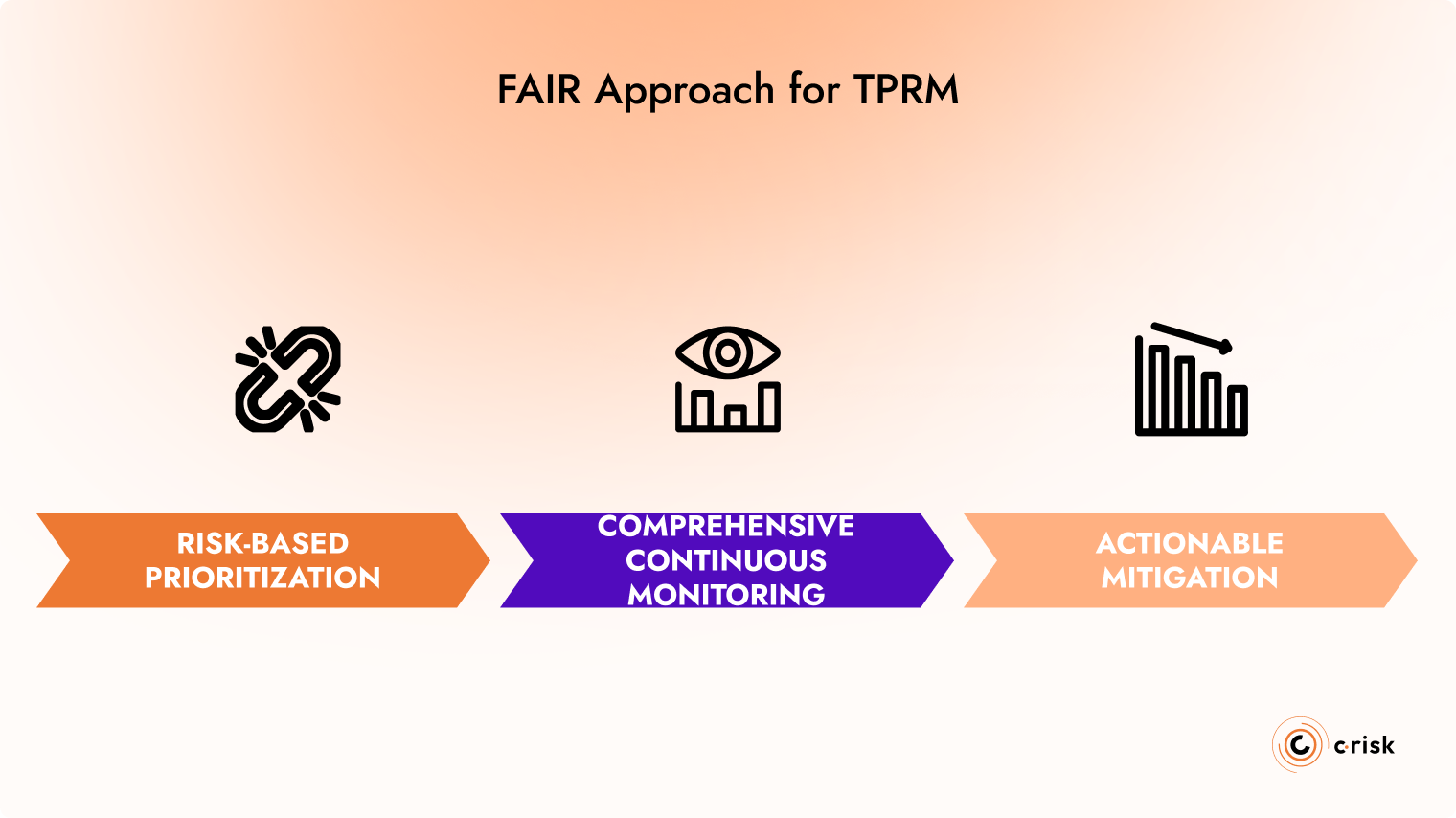
Recognizing that vendor and supply-chain risk bring extra uncertainty, the FAIR Institute introduced FAIR-TAM™ (Third-Party Assessment Model) as an extension to better analyze third-party cyber risk. FAIR-TAM applies FAIR’s core logic to vendor relationships by combining risk-based prioritization, continuous telemetry-driven monitoring, and actionable mitigation planning. Rather than relying on static questionnaires or surface scans, FAIR-TAM emphasizes assessing how much loss a vendor’s access or integration could cause, modeling how controls reduce that exposure, and focusing limited resources where they strengthen resilience.
Operational implementation of an effective cyber TPRM program
Establishing a risk-based methodology is only the first step. Turning it into an operational and sustainable program requires robust governance, clear accountability, and the right technological enablers. In practice, many organizations struggle not because they lack frameworks, but because ownership is fragmented, responsibilities are unclear, and manual processes cannot keep pace with the scale and complexity of today’s third-party ecosystems.
Structuring the organization for effective third-party cyber risk management
An effective TPRM governance framework should mirror corporate governance: accountability, defined decision paths, and measurable oversight.
In mature programs, responsibilities are distributed across a steering committee that brings together IT, legal, procurement, and risk management. For example, the COO ensures alignment with corporate strategy, the CISO oversees operational risk management, while the DPO and General Counsel guarantee compliance with data protection and contractual clauses.
This multidisciplinary governance ensures that cyber TPRM becomes a standing agenda item in enterprise risk committees and not an isolated IT control.
A structured model provides ownership, escalation paths, and KPIs such as supplier coverage rate, number of high-risk vendors mitigated, and mean time to remediate third-party findings.
Tools and technologies to automate third-party risk management
Despite growing investment in third-party risk programs, results remain inconsistent. Gartner reports that 75% of security and risk leaders now spend more time on third-party cybersecurity management than in 2021, yet incidents causing business disruptions have increased by 45% over the same period. This paradox highlights a central limitation of traditional approaches. Manual, point-in-time assessments cannot scale to meet the complexity and velocity of today’s digital supply chains.
Automation and data integration are essential to maintain visibility, consistency, and speed across the third-party risk lifecycle. At C-Risk we recommend that a third-party tool combines outside-in intelligence, continuous control assessment, and quantitative analytics based on the FAIR model to transform data into actionable insights across functions. These capabilities enable organizations to:
- Centralize supplier and automatically map third parties to critical business assets and data flows
- Continuously monitor vendors’ external security posture using security-rating feeds, threat intelligence, and vulnerability telemetry
- Quantify exposure in financial terms by linking cyber threat data to FAIR-based loss scenarios, highlighting where risk reduction yields the greatest return on investment
- Automate reassessments when vendor circumstances, technologies, or exposure levels change, aligning with DORA’s and NIS2’s call for continuous oversight
Tooling doesn’t replace human judgment. It supports data-driven decision-making at scale. By consolidating third-party risk management across the enterprise and applying quantitative models, organizations shift from reactive compliance to proactive, data-driven oversight. Measured risk assessments allow security and procurement teams to prioritize third parties by real exposure, not assumptions, strengthening both resilience and operational efficiency while ensuring human expertise is focused where it creates the greatest value.
Cyber TPRM as a driver of resilience and business value
Measuring effectiveness and demonstrating value
Rather than treating TPRM as a cost center, leading organizations now view it as a measurable investment in operational resilience. The FAIR model and its extensions such as FAIR-TAM make it possible to express third-party cyber risk in financial terms, turning technical control data into business metrics that executives understand.
By integrating these models into continuous assessment workflows, organizations can track risk-exposure reduction and control effectiveness over time—just as they would monitor financial performance. Quantification of third-party risk enables a common language between cybersecurity, procurement, and finance, enabling data-driven decisions on where to invest for the highest return on risk reduction.
This shift toward measurable value sets the stage for quantifying return on investment in cyber TPRM, showing not only how risks are reduced, but how each euro spent translates into improved resilience and avoided loss.
From visibility to value: How C-Risk enables data-driven third-party resilience
C-Risk helps organizations move from static third-party risk assessments to continuous, financially quantified oversight.
Our approach combines advanced analytics and automation to operationalize the FAIR methodology across the entire vendor lifecycle - from onboarding to real-time monitoring.
Through data-driven quantification, automated control evaluation, and business-aligned reporting, C-Risk enables enterprises to:
- Quantify third-party exposure in financial terms, supporting strategic investment and insurance decisions
- Prioritize remediation and supplier engagement based on measurable risk reduction
- Integrate third-party risk metrics into enterprise dashboards, connecting cyber exposure to business impact
- Demonstrate compliance with evolving frameworks such as DORA, NIS2 through defensible, evidence-based risk management practices