Cyber Incident Response and Cyber Insurance: How to Protect Your Business and Your Claim
When a ransomware attack encrypts critical systems or a business email compromise diverts a payment, the clock starts immediately. The organization must contain the incident, maintain operations, meet regulatory obligations, and activate its cyber insurance coverage, all at the same time. This article looks at what an effective incident response plan requires, how your cyber policy functions as a crisis management resource, and what it takes operationally to protect your claim.
- An incident response plan needs to be tested and reviewed regularly so that everyone with a response role is prepared.
- Cyber insurance provides access to a network of experts that can significantly reduce the impact and duration of an incident.
- Communicating with your insurer and sharing information throughout the incident ensures your policy responds as intended.
Building an Effective Incident Response Plan
Drafting Your IRP Document
An incident response plan (IRP) is a documented, tested set of procedures that defines how your organization detects, responds to, and recovers from a cyber incident. It is a step-by-step instruction manual of what to do and who does what from the moment an incident is declared.
Without an incident response plan, response becomes improvised. Improvised responses take longer, cost more, and produce incomplete documentation. Effective detection and response capabilities can significantly reduce the cost and impact of cyber incidents. The IRP is what makes those capabilities operational.
The core components an IRP needs to address:
- Incident classification criteria: A clear definition of what constitutes a reportable incident and a severity scale that determines the level of response required.
- Roles and responsibilities: Who leads the response, who handles technical containment, who manages internal and external communications, and who has authority to make decisions.
- Contact lists and escalation paths: Internal escalation chains, external legal and forensic contacts, regulatory notification contacts, and the insurer hotline. These need to be accessible independently of systems that may be compromised during an incident, which means a printed copy in the hands of every person with a response role.
- Containment, eradication, and recovery procedures: Specific playbooks for the incident types most relevant to your organization. A ransomware playbook and a BEC/funds transfer fraud playbook address different attack chains and require different immediate actions.
- Communication procedures: How the organization communicates internally during an incident, how it manages external communications with customers, regulators, and the media, and who has authority to speak on behalf of the organization.
- Evidence preservation: Procedures for maintaining a detailed, timestamped record of all actions taken, systems affected, and costs incurred from the moment an incident is declared.

Testing and Maintaining Your IRP
Tabletop exercises are one of the most effective ways to test your IRP documentation before a real incident forces you to. A tabletop exercise is a facilitated discussion where key stakeholders walk through a simulated incident scenario in real time, without actually activating systems or deploying resources. Everyone stays in the room, or on a call, and talks through what they would do at each stage.
For example, the facilitator announces: "It is 11pm on a Friday. Your SOC has detected anomalous encryption activity spreading across file servers. The on-call engineer has isolated the affected segment. What happens next?"
The exercise then walks through:
- Who gets called and in what order
- Who has authority to declare a formal incident
- How the Incident Manager coordinates without getting pulled into technical tasks
- When and how the insurer gets notified
- Which forensics firm gets engaged and whether they are on the approved panel
- How internal and external communications are managed
- How evidence and costs start being documented
The value of the exercise is finding out whether the plan is effective and where it breaks down. Common failures that surface: the insurer hotline number is wrong, nobody knows who owns the communication role, the Incident Manager has changed roles, the approved vendor list was last updated two years ago, and no one knows where the current version is.
The incident response plan needs to be updated to reflect what was learned. Beyond that, the IRP should be reviewed at minimum annually to stay current with changes to your systems, your organization, and the regulatory environment. NIS2 obligations, for example, continue to evolve as member states implement the directive, and your IRP needs to reflect those updates as they apply to your sector and jurisdiction.
Cyber Insurance Incident Response and Crisis Management
Cyber insurance serves two purposes: it transfers the financial cost of an incident that exceeds your risk appetite, and it gives you access to a pre-vetted network of crisis management specialists, forensic investigators, legal counsel, and communications firms. This access to experts ensures your response plan is effective when your business is threatened.
What a Cyber Insurance Policy Gives You Access To
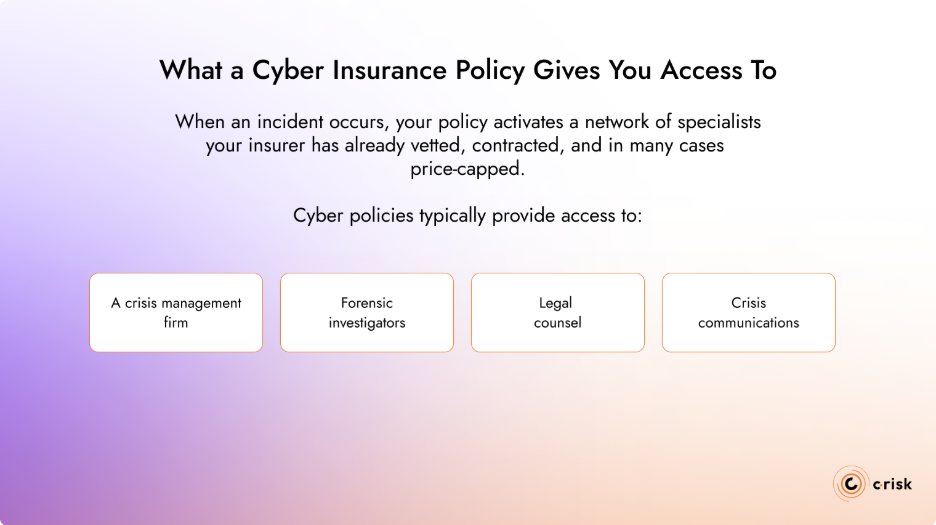
When an incident occurs, your policy does more than cover costs. It activates a network of specialists your insurer has already vetted, contracted, and in many cases price-capped. That matters because during an incident you do not have time to source vendors, negotiate fees, or assess whether a law firm has handled a ransomware case before.
Cyber policies typically provide access to:
- A crisis management firm: The insurer typically provides a list of approved external firms to avoid conflicts of interest, which have cyber-specific experience, and operate at pre-negotiated rates.
- Forensic investigators: To determine the scope and origin of the attack, preserve evidence, and produce the documentation regulators and claims adjusters will require.
- Legal counsel: Specialist cyber attorneys who understand breach notification obligations, regulatory exposure, and how to manage communications in a way that protects the organization legally.
- Crisis communications: For managing external messaging to customers, partners, and the media during and after an incident.
These resources are only effective if they are integrated into your IRP before an incident occurs. If your team does not know who to call, in what order, and under what conditions, you can’t benefit from your cyber policy. The insurer hotline and approved providers’ contact information need to be kept up to date in the IRP document.
Getting Your Vendors Approved Before an Incident
The crisis management team, the forensic investigators, and the legal counsel all should be approved before an incident, not during one. During an active incident, there is rarely time to request vendor approval or for the insurer to evaluate new providers. And engaging an unapproved vendor during incident response, even a competent one, can result in those costs being excluded from an insurance claim.
If your organization has preferred vendors, a forensic firm you have worked with or a law firm with sector-specific experience, get them on the approved panel before you need them. That means having the conversation with your broker and including it in the IRP process, not a phone call during an active incident.
The same logic applies to your crisis management lead. Insurers typically define who this is, partly because costs are pre-negotiated and partly to avoid conflicts of interest. An external, insurer-approved crisis management firm will have prior experience and operates at pre-agreed rates. If you want input into which firm you use, it should be raised before an incident has been declared.
Your Insurer is Not Your Adversary
Sharing Information with Your Insurer During an Incident
Your insurer and broker have a common interest in resolving the incident efficiently and at the lowest possible cost. That sounds obvious, but in practice many organizations treat their insurer as an adversary during a claim notification process, withholding information or delaying communication out of concern it will be used against them.
Brokers typically work alongside legal counsel under common-interest privilege arrangements during incident response. Keeping your insurer informed from the moment an incident is declared:
- Allows them to mobilize the right resources faster
- Enables better decisions about vendor deployment
- Keeps costs under control for both sides
Early cyber insurance notification activates the full response ecosystem your policy provides. It is important to ensure that the hotline number is known to the person responsible for notification. The earlier the call is made, the faster resources can be deployed.
Cyber Incident Documentation for Insurance Claims
Cost documentation starts the moment an incident is declared and continues throughout the response. Each vendor engagement, internal resource cost, and affected system should be documented with supporting evidence that justifies the cost.
Your insurer will use this evidence when evaluating the cyber insurance claim to ensure the policy responds as intended.
What gets documented and how:
- Forensic investigation: The firm's engagement letter, scope of work, hourly logs, and findings report
- Internal resource time: IT and security staff time logs detailing who worked on what and for how long
- Business interruption: Which revenue-generating systems were down, for how long, and the revenue lost or deferred as a result
- Ransom demand and negotiation: All correspondence related to the demand, negotiation, and any payment
- Legal fees: Counsel engaged, the scope of their involvement, and invoices
- Notification costs: Where personal data was breached, the cost of notifying affected individuals and regulatory filings under GDPR or HIPAA regulations
It’s important to share documentation with your insurer as the incident progresses. Your insurer can help flag gaps in real time and advise on what additional evidence is needed. It is far easier to collect during the incident than afterwards. The insurer's interest in fast, well-documented recovery is the same as yours: business interruption accounts for over 50% of large cyber claim values, and every hour the business is down costs both sides.
Connecting Incident Response to Cyber Risk Strategy
An incident response plan that integrates your cyber insurance policy ensures you have access to the appropriate resources in a timely manner. Defined roles, insurer-approved vendors, and clear documentation procedures mean your organization can act quickly, contain costs, and recover losses when an incident occurs, with the policy absorbing what would otherwise fall entirely on the business.
How that policy is structured is equally important. Sublimits, retentions, and exclusions should reflect your actual financial exposure to your top incident scenarios. Cyber risk quantification using the FAIR methodology enables CISOs to measure cyber exposure in financial terms and communicate that risk clearly to executives, boards, brokers, and underwriters when negotiating coverage and policy structure.
How C-Risk Can Help
C-Risk works with CISOs, CFOs, and risk leaders to build the connection between incident response planning, quantified risk exposure, and insurance coverage decisions.
Using the FAIR methodology, we quantify your top loss scenarios in financial terms, map those results to your policy structure, and identify where your current coverage may be under- or over-insuring your actual risk.
C-Risk supports security and risk leaders in:
- Quantifying top cyber risk scenarios using FAIR
- Mapping FAIR loss categories to policy structures to identify coverage gaps and misaligned sublimits
- Preparing data-driven executive reports to communicate cyber risk in financial terms
- Deploying the SAFE One CRQ platform to automate and operationalize quantitative risk analysis
If you are approaching a cyber insurance renewal or reviewing your incident response plan, a quantified view of your cyber risk exposure is the starting point.