Implementing a Modern TPRM Program: A Practical, Data-Driven Guide for Risk Leaders
Third-party risk has become one of the most material sources of cyber and operational exposure. Nearly one in three data breaches now originate from vendors or service providers, and many involve cloud or software suppliers that sit deep in the value chain. As the extended enterprise expands, point-in-time approaches based can’t keep pace. What organizations need is a measurable, risk-based and technology-supported TPRM that aligns with business growth and strengthens cyber resilience.
This article outlines a practical, multi-phase roadmap for implementing an effective, scalable third-party cyber risk management program aligned with enterprise strategy and regulatory expectations.
- A unified third-party inventory is the basis of an effective TPRM program, identifying how vendors extend your attack surface and where they intersect with critical business processes.
- Prioritizing third parties by business impact creates a defensible, risk-based foundation for decision-making.
- Audience-specific dashboards translate data into clear insights and recommended actions, enabling data-driven decisions that reflect the organization’s risk appetite.
- Automation and TPRM platform integration centralize workflows, evidence, and risk insights, helping teams make consistent decisions and scale their TPRM program effectively.
Start with Strategy: Align TPRM to Business Priorities
A strong TPRM program begins with asking the right question: What are you trying to protect, and why?
Define objectives that support enterprise strategy
- Connect TPRM goals to business continuity, regulatory compliance, and business growth
- Establish measurable KPIs that track program performance, such as control effectiveness, reduction of ALE, return on security investments (ROSI)
- Strengthen cross-functional communication and vendor collaboration
Assess current maturity and gaps
An implementation roadmap should begin with a clear understanding of where the program stands today. For many organizations third-party cyber risk is still managed in silos, with cyber, procurement, legal, and business units each running their own processes. A maturity assessment will cover:
- How TPRM activities are currently distributed across the organization
- Whether the program has a unified scope, taxonomy, or methodology
- Gaps in vendor inventories, onboarding workflows, or risk assessments
- Levels of automation, monitoring, and governance supporting the process
- Dependencies between cyber, operational, and regulatory requirements
A 2023 Cyentia study shows that organizations using multiple data sources to build their vendor inventories identify almost twice as many relevant vendors compared to those relying on a single source.
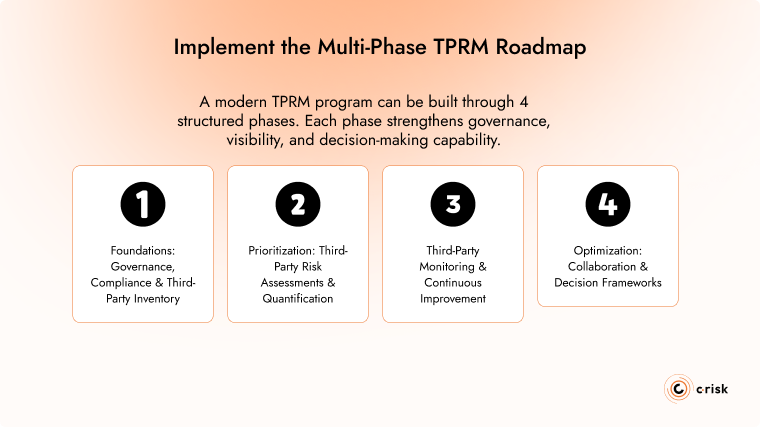
Implement the Multi-Phase TPRM Roadmap
A modern TPRM program can be built through four structured phases. Each phase strengthens governance, visibility, and decision-making capability.
Phase 1 - Foundations: Governance, Compliance & Third-Party Inventory
A robust TPRM program begins with full visibility. Your external attack surface is no longer limited to internal systems — it extends across every supplier, SaaS platform, service provider, and subcontractor you rely on. Without a complete inventory, organizations cannot understand where risk originates or how a vendor failure could propagate across operations.
Establish governance that unifies fragmented functions
TPRM fails when it is run in silos. Third-party governance policies at the enterprise level bring coherence to processes that typically sit across multiple teams:
- Procurement
- IT & Cybersecurity
- Legal & Compliance
- Data Protection
- Business owners
- Risk Management
Mature organizations formalize this collaboration through various committees, documented workflows, and shared decision criteria.
Build a complete, business-aligned third-party inventory
Most organizations underestimate how many external parties have direct or indirect access to data, systems, and processes. Shadow IT, decentralized purchasing, and uncontrolled SaaS adoption quietly expand the attack surface.
A 2023 survey from Kaspersky reports that 11% of cyber incidents were caused by unapproved applications introduced by employees — a direct consequence of unmanaged third-party adoption.
A unified, enterprise-wide inventory allows risk teams to connect external dependencies to business impact. It should capture:
- All third parties across the enterprise
- The data, systems, and privileged access each vendor touches
- Dependencies linked to revenue-generating activities or regulated processes
- Where each vendor contributes along the value chain and which operations rely on them
This inventory becomes the foundation for prioritization, quantification, monitoring, and data-driven decision-making.
Phase 2 - Prioritization: Third-Party Risk Assessments & Quantification
Not all third parties represent the same level of risk. Prioritization is the hinge that links due diligence to meaningful action.
Use business impact and dependencies to triage
Before any questionnaire or external scan, organizations should answer:
- Does the vendor access critical or sensitive data?
- Does it integrate with internal systems?
- Does it support revenue-generating activities?
This high-level triage alone can dramatically improve focus compared to contract-based prioritization, which does not correlate to risk.
Quantify third-party risk using FAIR
Quantification helps answer the most important question an executive will ask the CISO:
“How much financial risk does this vendor represent for us?”
FAIR breaks cyber and technology risk into:
- Loss Event Frequency (how often a scenario could occur)
- Loss Magnitude (the cost if it does)
Quantification often overturns assumptions. A €50k-contract vendor with access to sensitive customer data may create millions in potential loss, while a major cloud provider may represent lower exposure thanks to strong controls and redundancy.
FAIR-TAM extends this methodology to third-party ecosystems, enabling consistent, scenario-based assessment and prioritization.
Phase 3 - Third-Party Monitoring & Continuous Improvement
TPRM can’t be treated as a once yearly exercise. The threat landscape is changing every day. Because third parties are an extension of your attack surface, it is critical to identify threats and maintain effective controls to keep risk within your risk appetite.
Implement continuous monitoring
Data-driven TPRM programs combine:
- CRQ-based cyber risk management platform
- External attack surface monitoring
- Threat intelligence
- Change alerts
- Control drift detection
- Automated re-scoring
Automation helps teams stay ahead of change — especially in organizations with thousands of suppliers. Gartner notes that while leaders spend significantly more time on TPRM than in 2021, third-party incidents causing business disruption increased by 45%, which can be explained by the limitation of qualitative approaches to third-party vendor risk management.
Use data-informed, business-focused dashboards to guide decisions
Dashboards enable each stakeholder group to make timely, informed, and defensible decisions. Effective TPRM dashboards are tailored to the audience. For example, executives need to understand financial impact of decisions and understand trends; operational teams need control insights and remediation priorities.
When dashboards are built on quantitative, FAIR-aligned data, the insights become even more actionable. Quantification provides a common financial language that allows cyber, risk, and business leaders to interpret risk the same way.
Dashboards should make it easy to understand:
- Where exposure is concentrated across the third-party ecosystem
- How risk is evolving over time, including material shifts that require attention
- Which vendors require engagement or remediation, based on measurable criteria
- Where collaborative efforts deliver value, such as improved controls or reduced financial exposure
FAIR-based metrics allow teams to express these insights in financial terms, helping decision-makers prioritize actions that meaningfully reduce exposure and align with the organization’s risk appetite.
Phase 4 - Optimization: Collaboration & Decision Frameworks
Once visibility and measurement are in place, organizations can mature toward defensible, business-aligned decisions.
Strengthen collaboration with critical suppliers
Third-party collaboration is an important differentiator in cyber resilience. Effective partnerships begin with clear expectations and transparent communication, supported by regular exchanges of telemetry or relevant findings. Critical suppliers benefit from co-developed remediation plans and aligned incident-response processes that ensure both sides can act quickly when issues arise. Collaborative vendor relationships consistently outperform transactional ones because they create shared understanding, improve control alignment, and strengthen the organization’s capacity to respond to and recover from incidents.
Adopt a structured decision framework
A defensible TPRM decision framework provides clarity on how vendor risks are evaluated and treated, establishing consistent criteria for assessing exposure, applying quantification methods, defining approval thresholds, and determining what evidence is required to support decisions.
It also ensures that documentation is complete and audit-ready, enabling organizations to demonstrate compliance with internal governance requirements and external regulations. Frameworks such as DORA and NIS2 increasingly require organizations to maintain clear, traceable rationales for third-party decisions, moving toward transparent, evidence-based processes.
Technology as an Enabler: Integrating Unified Third-Party Risk Management Platform
Tools and Technologies: Outside-In Visibility and Unified TPRM Workflows
Technology is essential for scaling TPRM and maintaining a reliable view of a rapidly evolving vendor ecosystem. Risk scoring using outside-in intelligence can help reveal signals that help prioritizing risk treatment or new controls. Combined with a quantitative third-party risk management platform, you can perform FAIR-based assessments and collaborate across functions. It also supports compliance efforts with documentation and evidence collection. Some of the latest TPRM tools integrate AI agents to help with the manual process of questionnaires as well.
Some of the benefits of a TPRM platform are:
- Vendor risk scoring based on outside-in telemetry
- Control assessments that evaluate security maturity
- Automated quantitative analysis using FAIR principles
- Prioritization workflows focused on business impact and exposure
- Evidence collection and documentation to support audits and governance
- Centralized communication so security, procurement, legal, and business teams operate from a shared view of vendor risk
We support organization in the implementation and integration phases to ensure that the platform aligns with existing internal processes, data sources, governance models and compliance requirements, so that organizations are able to operationalize TPRM efficiently without adding complexity.
What a Mature, Data-Driven TPRM Program Looks Like
A mature, data-driven TPRM program is risk-based and anchored in real exposure rather than contract value, ensuring that oversight focuses where it matters most. It is supported by objective, data-driven evidence that strengthens assessments and informs decisions, while continuous monitoring and automated workflows keep the program aligned with evolving vendor conditions. Collaboration with critical suppliers becomes part of everyday operations, enabling shared resilience and more effective remediation. Quantitative methods such as FAIR translate cyber and operational exposure into financial terms, creating a common language for business and risk leaders. The result is a defensible program in which every decision follows clear, transparent rationale consistent with governance requirements and regulatory expectations.
Third-Party Cyber Risk Management: From Visibility to Value
Most organizations still manage third-party risk through manual, fragmented, and compliance-driven processes that cannot keep pace with today’s ecosystem. Operationalizing TPRM, by unifying data, automating assessments, and adopting quantitative methods, turns an outdated workflow into a strategic capability with real ROI. The result is a program that not only scales as you grow but also delivers measurable business value through clearer prioritization, defensible decisions, and stronger cyber resilience.
C-Risk supports organizations in modernizing their third-party risk management approach by helping them build a mature TPRM program. We work with teams to operationalize processes, integrate quantitative methods, and establish the governance and workflows needed to manage third-party risk at scale.
If your current TPRM program is ready to scale, we can help you transform it into a data-driven capability that supports your business objectives.