Translating Cyber Risk into Financial Impact: Creating a Common Language Within Your Organization
When a major healthcare IT provider suffered a ransomware attack in 2024, it paralyzed hospital billing systems nationwide and led to an estimated $3 billion in total costs. Incidents like this underscore why translating cybersecurity risks into financial terms is so critical.
By understanding the impact of cyber risk in financial terms, organizations across industries can better understand the business impact of cyber threats to make more informed risk management decisions. This article explores the why and how for understanding cyber risk quantitatively, how it improves decision-making, examples of effective communication, and key financial metrics for cyber risk management.
- Financial translation improves decision-making: Expressing risk in financial terms drives stronger alignment with the board and senior management.
- Methods for converting technical cyber risks into financial value: Frameworks like FAIR turn complex threat scenarios into measurable financial terms that resonate with decision-makers.
- Common use cases for cyber risk quantification: From board reporting to cyber insurance, measuring the financial impact of cyber risk supports critical functions across the organization.
- Key metrics (KPIs and KRIs) for financial risk communication: Performance and risk indicators link cyber initiatives to business outcomes and improve transparency.
Financial Impact Makes Cyber Risk Accessible
As business leaders are compelled understand the operational impact of cyber risk, CISOs are complementing their cyber risk management strategies with quantitative methods to contextualize and communicate risk in a way that qualitative methods don’t fully address. Cyber risk quantification is a way to communicate with executives that allow them to compare investment activity and performance. Essentially it can inform better allocation of resource or enable defendable decisions.
Understand what is at stake
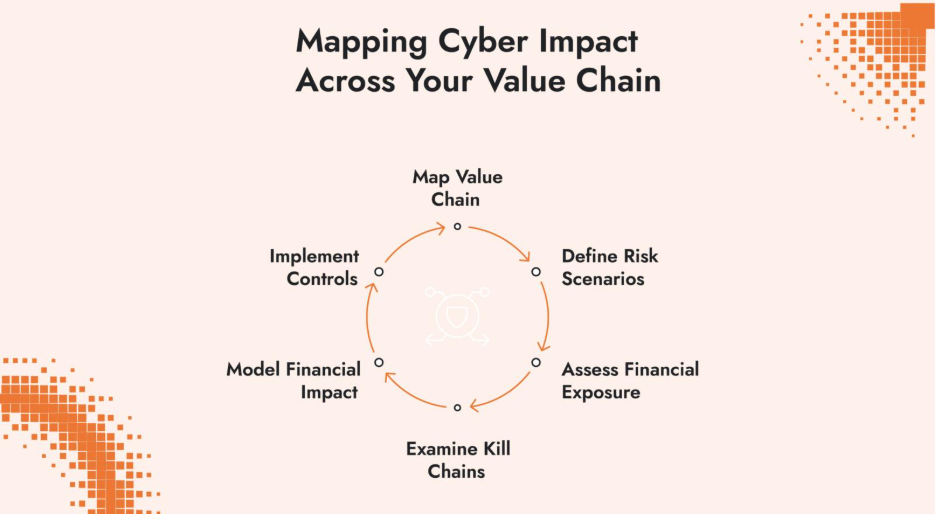
To estimate the financial impact of cyber risk, organizations must first establish a clear picture of what matters most to the organization. In a cyber risk management context, this starts with identifying the critical digital assets and business processes that are essential to operations and revenue generation. This can be modeled as a value chain.
A value chain is the series of interlinked processes and digital assets that contribute to delivering a product or service and generating revenue. Mapping it helps identify where cyber threats could cause significant business disruption.
From there, they define the most relevant risk scenarios and assess the company’s exposure in financial terms. By examining common kill chains and understanding which controls are currently in place, teams can begin to model the potential financial impact of different threats and where to intervene for maximum cost-effective risk reduction.
Enable defensible, data-driven communication
Quantifying the impact cyber risk in financial terms enables more effective communication with both internal and external stakeholders. Business leaders and board members can better understand the organization's overall financial exposure to cyber risk, while regulators expect boards to document their prioritization and impact of specific cyber risk events. With clear, quantified data, security leaders can also identify which resilience measures will have the greatest return on risk reduction, supporting informed conversations about security investments and risk appetite.
Make informed, risk-based decisions
The end result is that business leaders are able consider cybersecurity investments just like any other business initiative.
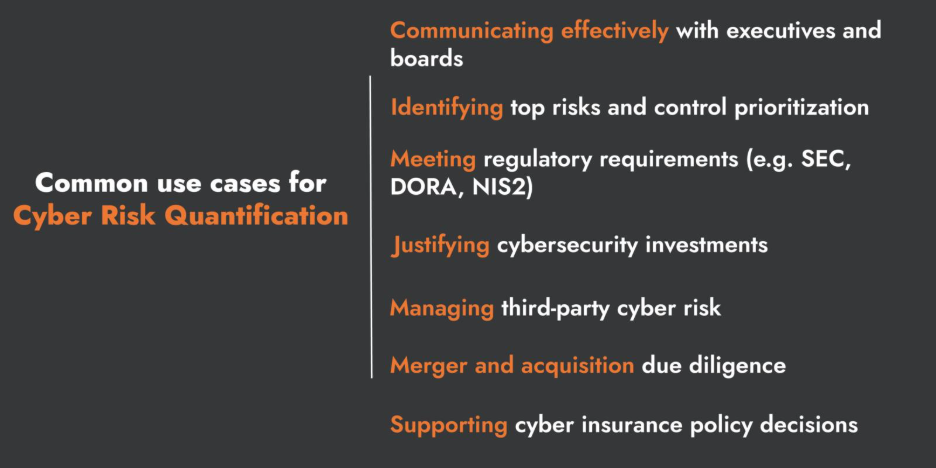
There are many use cases where quantifying cyber risk can augment understanding by business leaders.
Common use cases for Cyber Risk Quantification:
- Communicating effectively with executives and boards
- Identifying top risks and control prioritization
- Meeting regulatory requirements (e.g. SEC, DORA, NIS2)
- Justifying cybersecurity investments
- Managing third-party cyber risk
- Merger and acquisition due diligence
- Supporting cyber insurance policy decisions
Ultimately, understanding the financial impact of risk equips decision-makers with the context and data-supported insights to act, turning cyber risk into a measurable, strategic part of enterprise strategy.
How Financial Risk Translation Improves Decision-Making
Expressing cyber risks in monetary terms doesn’t just quantify potential losses – it tangibly improves decisions at all levels of the organization. When security issues are framed as business issues, stakeholders can rationalize investments, prioritize initiatives, align with strategy, and integrate cyber risk into enterprise risk management more effectively.
Translating cyber risk into financial impact begins with building a structured dataset. This includes identifying critical assets, mapping value chains and risk chains, and cataloging the controls already in place. From there, internal and external data points—such as loss history, threat intelligence, and industry benchmarks—are used to estimate how likely a risk is to occur and how costly it would be if it did. With this foundation, organizations can start expressing cyber risk in monetary terms that support meaningful decisions.
Driving Better Security Investment Decisions
One immediate benefit of translating technical risk to financial value is the rationalization of cybersecurity investments. When both risks and proposed controls are quantified in ROI terms, organizations can evaluate where each dollar spent would reduce the most risk.
Instead of relying on gut feeling or generic “high/medium/low” labels, executives see clear cost–benefit analyses: “Spending $1M on improving our cloud backups will avert an expected $5M in annual loss from ransomware”. This evidence-based approach prioritizes security initiatives that deliver the greatest risk reduction for the cost.
It also helps in defending budgets. CISOs can justify requests by demonstrating the expected loss reduction or savings from avoided incidents.
A study by MetricStream shows that 81% of C-suite executives who quantify cyber risk have seen increased focus and productivity on strategic security matters.
In short, financial risk metrics bring much-needed clarity and precision, ensuring that limited cybersecurity resources are allocated to the most impactful areas.
Aligning Cyber Risk with Business Strategy and Enterprise Risk Management
Translating cyber risk into financial terms also elevates cybersecurity discussions to the strategic level. When risks are expressed using the same units as revenue, profit, or other business metrics, it reinforces alignment with corporate objectives. Business leaders can weigh cyber threats against other enterprise risks using a common currency.
This integration fosters a risk management culture where cybersecurity is not a siloed IT concern but part of the overall business strategy.
For example, boards of directors and CEOs gain visibility into what’s truly at stake financially, which helps them set risk appetite and make informed decisions on cybersecurity policies. It also enables enterprise risk management (ERM) teams to compare cyber risk scenarios alongside market, operational, and other risks – facilitating a holistic view.
Ultimately, speaking the financial language of risk ensures that cybersecurity initiatives support the company’s broader goals and risk tolerance. The result is better cross-functional understanding and consensus on how to manage cyber risks proactively.
Examples of Effective Financial Risk Communication
Translating technical risks into monetary terms is only half the battle – the insights must be effectively communicated. Below are examples of how organizations can convey cyber risk information in financial terms to various stakeholders, ensuring the message resonates and drives action.
Tailoring Risk Reporting and Dashboards to the Audience
Different stakeholders consume risk information differently, so one-size-fits-all reporting doesn’t work. Effective communication means tailoring the content and format to the audience. For instance, a technical team might use a detailed risk register, while executives prefer a high-level dashboard with financial metrics.
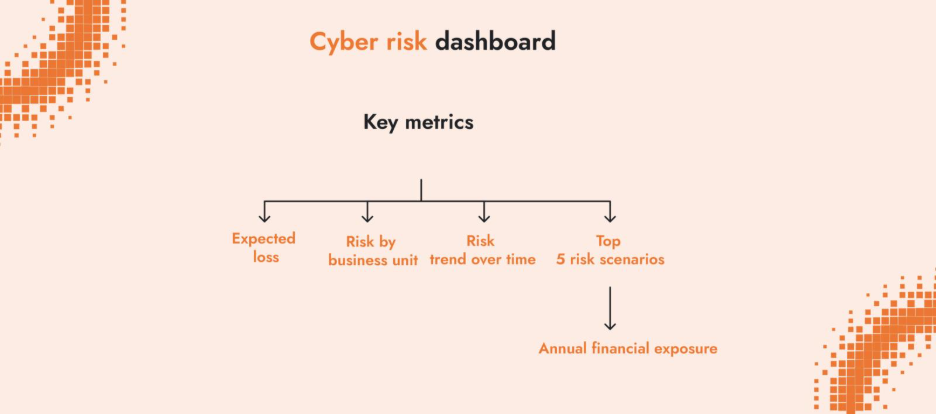
And effective cyber risk dashboard will visualize key metrics like expected loss, risk by business unit, and risk trend over time. They can include the top 5 risk scenarios and their annual financial exposure, making it easy for a CEO or board member to grasp the big picture. The goal is to present complex data in a digestible, business-oriented way.
The goal is to speak the stakeholder’s language.
Communicating with Regulators
Financially quantifying cyber risk has also become essential with external stakeholders like regulatory bodies. Regulators worldwide are increasingly expecting businesses to demonstrate robust cyber risk management in business terms at the board level.
For example, in 2023 the U.S. Securities and Exchange Commission enacted new rules requiring public companies to disclose their cybersecurity risk management strategies and report cybersecurity incidents that have material impact. This means that CISOs need to know more than just the technical cause of an incident.
Financial Metrics and Key Performance and Key Risk Indicators in Cyber Risk
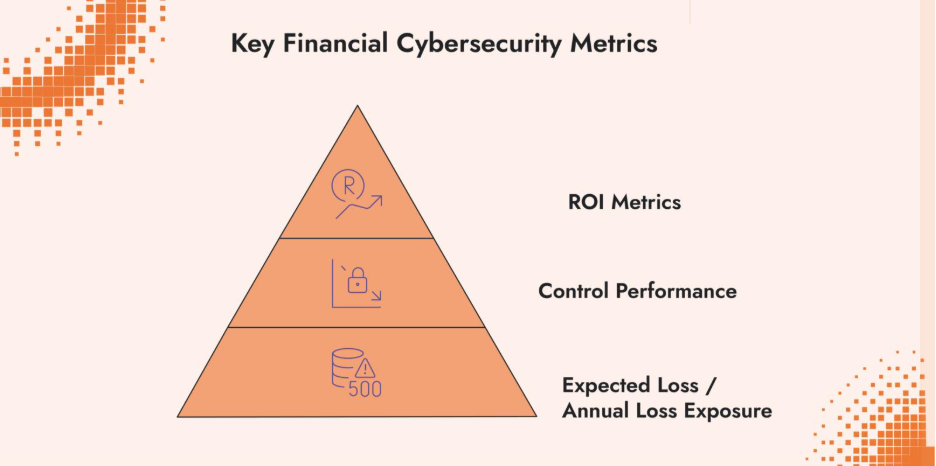
To manage and communicate cyber risk in financial terms, organizations track various key performance indicators (KPIs) and key risk indicators (KRIs). These metrics link cybersecurity with business outcomes, enabling ongoing measurement, benchmarking, and improvement of risk management effectiveness.
Key Financial Cybersecurity Metrics and Business Alignment
One fundamental metric is the expected loss from cyber events, often broken down by scenario and over a set period of time. Using the FAIR methodology, this is the Annual Loss Exposure (ALE) or the probability-weighted cost of potential cyber incidents.
Boards are especially interested in the likelihood of different cyber events and their potential financial severities. A CISO could be asked: “How likely are we to face a $10 million ransomware hit this year?”
Alongside that, organizations increasingly report business loss impact scenarios. These are narrative-driven metrics that answer: “If a specific scenario happens, what is the business impact in financial terms and the operational disruption?” For instance, a hospital might quantify the cost of a week-long electronic health record outage, including lost billing, diversion of patients, and so on.
Tied to these risk metrics are control performance and ROI metrics. Return on investment (ROI) for cybersecurity initiatives is a KPI that demonstrates value by comparing the cost of a security project to the reduction in expected loss achieved.
By correlating cybersecurity outcomes with business outcomes (like uptime, customer retention, and revenue protection), stakeholders see cybersecurity in the context of overall business performance. Ultimately, these financial metrics ensure that decision-makers can make useful comparisons.
Benchmarking and Tracking Risk Posture Over Time
Metrics can also be powerful when used to track progress and compare against peers. One important indicator is the organization’s cyber risk posture over time. This involves trending the quantified risk exposure year-over-year or quarter-over-quarter. Ideally, as security improvements are made, the expected financial loss should trend downward, or at least the confidence in handling larger incidents should improve. Showing a trend where probable loss is reduced (or a stable trend in the face of rising threats) is a clear sign of improved resilience. Conversely, if the likelihood of a loss increases over time, it signals the need for new strategies. Regular tracking of these metrics over time provides an early warning system and holds the security program accountable to results.
Benchmarking Against Industry Peers
Organizations also benchmark their cyber risk metrics against industry peers. Knowing how your financial risk profile compares to others in the same sector provides valuable context.
For example, a bank estimate that its loss for a major cyber event is 5% of annual revenue, whereas the industry average (from studies or consortium data) is only 3%. This gap might prompt a reevaluation of controls or spending.
Common benchmarks include:
- security spending as a percentage of IT budget
- average loss per cyber incident
- time to recover and associated losses relative to industry norms.
Cyber insurers and industry groups sometimes publish aggregate data that organizations can use for such comparisons. In addition, third-party risk metrics are emerging as important benchmarks.
By integrating these metrics into dashboards and regular reports, enterprises bring quantitative rigor to cybersecurity management. The evolution of these indicators over time demonstrates the tangible impact of security investments and risk mitigation efforts.
Using financial metrics, KPIs and KRIs, security and risk teams can manage cyber risk with the same approach as traditional business units, continuously improving and communicating in a language everyone understands.
C-Risk helps you understand the financial impact of cyber risk:
C-Risk helps you understand the financial impact of cyber risk:
- Quantify risk with FAIR™: Use the industry-standard methodology to model scenarios and express cyber risk in financial terms executives understand.
- Map risk to value: Visualize where disruptions in your value chain create the greatest financial exposure.
- Build business-ready dashboards: Create financial risk insights for boardroom discussions and strategic planning.
- Support regulatory compliance: Meet disclosure and oversight requirements from regulators like the SEC, DORA, and NIS2 with transparent, data-driven reporting.
- Benchmark resilience: Document your cyber risk management processes and prove the ROI of your security measures.
Whether you're seeking to justify your cybersecurity budget or align cybersecurity with enterprise strategy, C-Risk’s expert team provides the support and skills to move from cyber risk uncertainty to financial clarity.