Cybersecurity governance frameworks: Building the right model for your organization
Cybersecurity governance forms the foundation of enterprise resilience, defining how cyber risk decisions are made, who holds accountability, and how those decisions support strategic objectives. Despite widespread recognition of its importance, implementation remains inconsistent, as a one-size-fits-all approach often fails to reflect an organization’s unique context, resulting in fragmented oversight and inefficient resource allocation. In this article, we explore how to design a cybersecurity governance framework tailored to your organization’s structure, maturity, and regulatory environment, and how integrating it into corporate governance strengthens accountability, transparency, and long-term value protection.
- Defining an effective cybersecurity governance model that aligns with corporate objectives and regulatory obligations
- Key factors influencing framework design, including industry requirements, regulatory landscape, and organizational maturity
- Core components of strong governance such as accountability structures, reporting lines, and decision rights
- Enabling risk-based decisions through quantitative analysis, including the use of FAIR for financial risk modeling
- When to engage external expertise to validate, strengthen, or accelerate your governance model development
Understanding cyber governance fundamentals
What is cyber governance?
At its core, cybersecurity governance is a decision-making framework—one that defines how cyber risk is understood, prioritized, and addressed across an organization. It is not merely a collection of policies or oversight checklists; it is a dynamic structure by which authority, accountability, and escalation are coordinated in relation to cybersecurity. It will define who has the mandate to act, on what information, and within what boundaries of risk acceptance.
Effective governance does more than assign responsibilities—it creates clarity about how security leadership, IT teams, risk managers, and business units collaborate to protect the organization. By establishing clear accountability chains and transparent reporting mechanisms, governance builds trust among stakeholders who need confidence that cyber risks are being actively managed. This framework must connect directly to organizational objectives, ensuring that security decisions support the company's mission and strategic goals.
Corporate governance and cybersecurity
Cybersecurity governance should be embedded within existing oversight structures. Boards and executives must treat cybersecurity as they would any other form of enterprise risk—subject to monitoring, reporting, strategic alignment, and ultimately, executive accountability. A well-designed cyber governance model reinforces the same principles that underlie sound corporate governance: transparency, responsibility, and the protection of long-term value.
When implemented effectively, this integration creates a foundation for organizational resilience. Teams operate more efficiently when they understand their roles and decision rights. Leaders make better risk decisions when they have clear, consistent information flows. And the entire organization becomes more productive when security is an enabler of business objectives rather than a barrier to innovation.
Why a cyber governance model matters now
Regulatory pressure is intensifying—from the SEC’s cyber disclosure rules in the US to sector-specific mandates like DORA in the EU. Fines for a failure to meet cybersecurity governance requirements are steep. Boards and CISOs now also risk personal liability and even criminal penalties if they’re held liable in connection with a cyber incident.
In the US, D&O insurance policies are now essential to protect board members and officers. It is even common for CISOs to take out insurance to protect themselves from personal liability, a trend underscored by the case of the former CISO of Uber who was criminally charged for his role in concealing a security breach. The case draws attention to a critical point: governance structures are intended to protect the organization and individuals leading it by demonstrating .
Ultimately, cybersecurity governance enables defensible decision-making in moments of uncertainty. It ensures that decisions about cybersecurity are made by the right people, with the right inputs, and in alignment with the organization’s mission and obligations.
Key factors shaping your governance framework
A governance framework is not one-size-fits-all. The structure and formality of cybersecurity oversight is shaped by the organization’s operating context. This starts with the industry in which the company is operating. It defines baseline expectations for resilience, reporting, and regulatory scrutiny. From there, the geography and regulatory exposure introduce additional layers of complexity, especially in multinational contexts. Once those external obligations are understood, the internal company structure—ownership model, scale, and organizational maturity—will determine how complex or how simple the model will be. The goal is to adapt your governance model based on your organizational context.
Industry requirements
Every sector imposes different expectations on how cybersecurity governance should be structured. In financial services, for example, the Digital Operational Resilience Act (DORA) requires clear executive accountability, third-party risk oversight, and board-level reporting on ICT risk. In healthcare, frameworks like HIPAA impose specific security safeguards and auditability requirements, often tied to patient privacy. For critical infrastructure sectors—energy, transport, telecoms—national cybersecurity agencies often define mandatory governance obligations, including reporting lines and incident escalation paths. A cyber governance model must be calibrated to industry-specific mandates or risk non-compliance and enforcement.
Geographic and regulatory landscape
Once industry-specific obligations are understood, geography introduces additional dimensions. In the EU, regulations like GDPR and NIS2 define formal accountability structures, breach response protocols, and board-level responsibility. In the US, a decentralized legal framework places different requirements at federal and state levels—particularly through regulatory enforcement such as through the SEC.
For multinational organizations, the challenge lies in reconciling multiple regulatory environments. One jurisdiction may mandate breach notification within 72 hours while another requires notification within 24 hours. Effective governance models must reconcile these differences through a consistent decision framework.
Organizational structures influence your framework
Governance is also shaped by ownership and reporting lines. A privately held company may have more flexibility, while publicly traded companies must meet disclosure and audit oversight obligations. Private equity–backed organizations often report to centralized investment committees, requiring additional governance layers. Public sector entities typically follow statutory or ministry-defined governance mandates. The key is ensuring that cybersecurity oversight aligns with the leadership structure within the organization.
Company size and maturity
The size and complexity of an organization directly shape how its cybersecurity governance framework is structured for decision-making, risk oversight, and accountability. But how that structure is implemented will vary significantly. In smaller organizations, governance may be more centralized, with responsibilities concentrated among a few key leaders. As an organization grows, governance must adapt, becoming more distributed, layered across business units, and supported by specialized functions such as risk management, compliance, internal audit, and legal. Large organizations require formal escalation paths, delegated authority, and cross-functional coordination to ensure that cybersecurity decisions are aligned, timely, and defensible. In this way, governance evolves in response to operational and risk complexity.
For example, a founder-led payment SaaS company might model its cybersecurity governance framework around:
- Protecting sensitive financial data and platform APIs
- Meeting compliance requirements like PCI DSS, SOC 2, DORA and GDPR
- Managing fraud risk and access control in a fast-changing environment
- Assigning cybersecurity responsibility to the CTO or a small GRC/security team
- Involving a handful of key stakeholders: executive team, DevOps leads, and legal counsel
- Reporting directly to investors, auditors, and enterprise clients on risk posture
By contrast, a telecommunications provider would model its cybersecurity governance to support:
- Continuous availability of national communications infrastructure
- Compliance with NIS2, national telecom laws, and sector-specific resilience requirements
- Cyber risk management across IT, OT, legacy systems, and emerging technologies (e.g. 5G)
- A layered governance structure involving:
- Executive leadership (CEO, CRO, CSO, CISO)
- Board committees (e.g. Risk, Audit)
- Business units (network ops, regulatory, legal, procurement, BCP, SOC/NOC teams)
- Formal coordination with national cybersecurity authorities and regulators
- Incident escalation paths and governance playbooks that span legal, technical, and public communication functions
Essential components of an effective model
Regardless of size or complexity, every cybersecurity governance model must incorporate certain fundamental elements to function effectively. These components work together to create a decision-making system that balances risk, compliance, and business objectives.
Clear accountability and ownership
The foundation of any governance model is the clear assignment of cybersecurity responsibility. This starts with documenting who holds ultimate accountability for information security within the organization. For a smaller organization, this could be the CTO or an owner-operator wearing multiple hats. For a large company, the CISO will be responsible.
The key is ensuring this responsibility is formally documented and recognized at the board level. As regulatory frameworks like GDPR have demonstrated with Data Protection Officer requirements, independence considerations matter. The person responsible for cybersecurity should have sufficient autonomy to make decisions based on risk, avoiding conflicts of interest that could compromise an organization’s security posture.
Reporting structures and cadence
Effective governance requires regular, structured communication between security leadership and the board. At a minimum, this means annual reporting to the board or company owners. However, the frequency should align with the organization's risk profile - a financial services firm might require quarterly updates, while a small B2B SaaS company might find annual reporting sufficient.
The reporting structure should clearly define:
- Who presents the information (typically the CISO or security-responsible individual)
- Who decides (board, risk committee, audit committee, or executive team)
- What triggers additional reporting outside the regular cadence
- How information flows between different levels of the organization
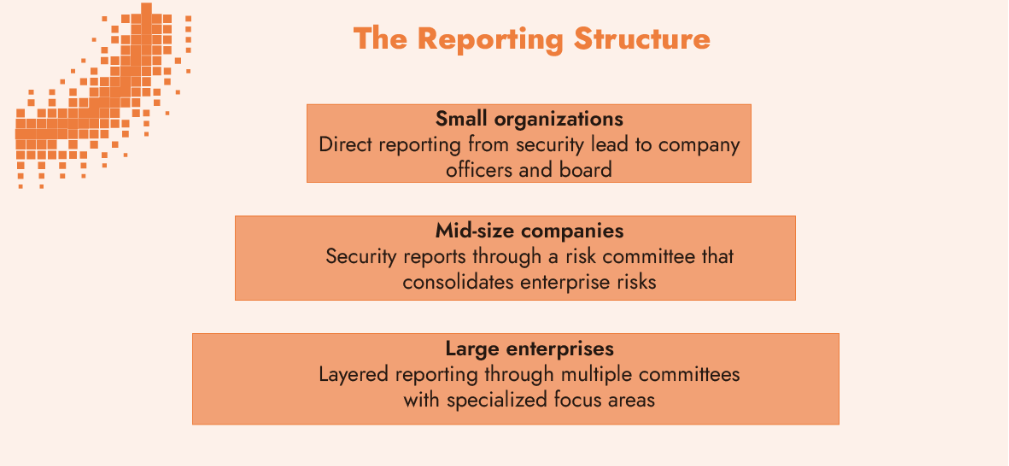
In practice, this might look like:
- Small organizations: Direct reporting from security lead to company officers and board
- Mid-size companies: Security reports through a risk committee that consolidates enterprise risks
- Large enterprises: Layered reporting through multiple committees with specialized focus areas
Risk-Based decision making
Governance structures must enable decisions grounded in actual risk rather than perception or politics. This requires moving beyond subjective, qualitative assessments ("high/medium/low") to data-driven metrics that can be consistently measured and compared over time.
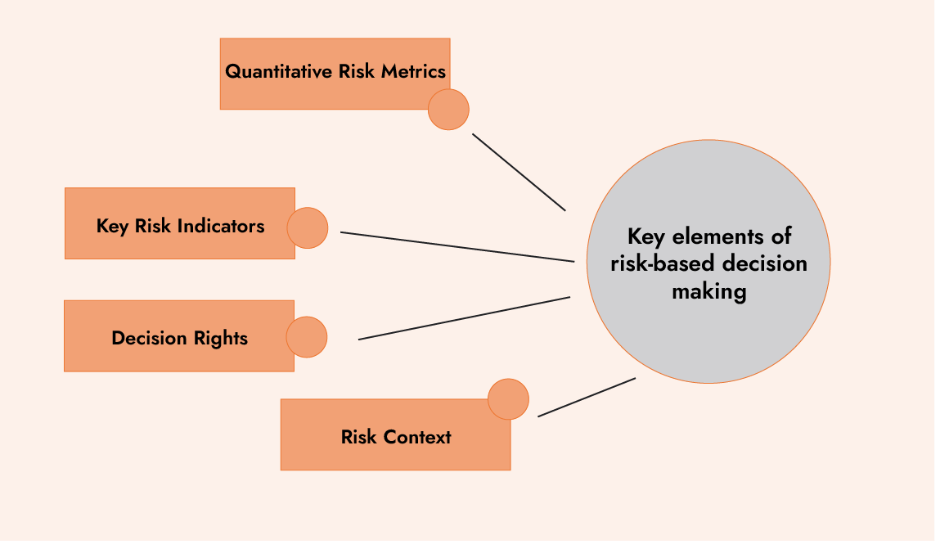
Key elements of risk-based decision making include:
Quantitative Risk Metrics: Instead of relying solely on color-coded heat maps, organizations should develop metrics that connect cyber risk to business impact. This might include potential financial loss, operational downtime, or regulatory penalties.
Key Risk Indicators: Regular monitoring of:
- Threat environment changes (new vulnerabilities, threat actor activity)
- Control effectiveness (patch compliance, security tool performance)
- Digital asset inventory (what needs protection and its criticality)
- Security maturity progression against frameworks
Decision Rights: Clear definition of who can accept which levels of risk. A line manager might approve low-risk exceptions, while board approval might be required for accepting risks above certain thresholds.
Risk Context: Ensuring decision-makers understand not just the technical risk but its business implications. A vulnerability in a customer-facing API carries different weight than one in an internal development system.
Stakeholder identification and engagement
Effective governance requires identifying all relevant stakeholders and defining their roles in the cybersecurity decision-making process. This extends beyond the obvious security team to include:
Internal Stakeholders:
- Board members and company officers
- Internal audit function
- Legal, procurement and compliance
- Business unit leaders
- IT and cyber risk teams
External Stakeholders:
- Investors
- Regulators
- Customers
- Cyber insurance provider
- External auditors providing independent assessment
The stakeholder map should be documented as part of the cybersecurity governance process, so that roles are clear.
Integration with corporate governance
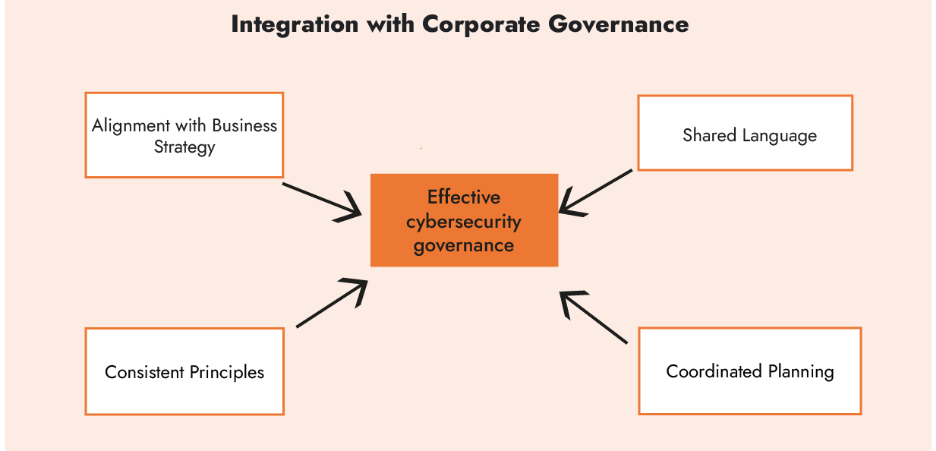
Effective cybersecurity governance should integrate seamlessly with existing corporate governance structures. This means:
Alignment with Business Strategy: Security decisions should support business objectives. If the company's strategy involves rapid expansion into new markets, the cyber governance model must enable quick but defensible decisions about acceptable cyber risk.
Consistent Principles: The same principles that guide corporate governance—transparency, accountability, and value protection—should extend to cybersecurity decisions.
Shared Language: Cyber risks should be presented in business terms that board members and executives understand. Technical metrics must translate to business impact. The use of the FAIR framework will facilitate risk communication.
Coordinated Planning: Cybersecurity initiatives should align with business planning cycles, budget processes, and strategic reviews. Data-driven methods will allow for clear cost-benefit analysis.
Measurement and continuous improvement
An effective governance model includes mechanisms for measuring its own effectiveness and evolving with the organization. This involves:
- Regular assessment of whether the governance structure is enabling good decisions
- Benchmarking against industry peers and standards
- Adjustment as the organization grows or regulatory requirements change
The goal is not to create perfect governance from day one, but to establish a foundation that can mature alongside the organization. A startup's simple yearly security review can evolve into a sophisticated committee structure as the company scales, but the core components remain constant.
The role of external support for cybersecurity governance
When to engage cybersecurity risk management experts
Organizations benefit from external support when they have limited resources (time or people) or a lack of expertise to conduct defensible data-driven assessments. It's particularly valuable when stakeholders demand independent verification, whether for investor due diligence, regulatory audits, or board assurance.
Benefits of external perspective
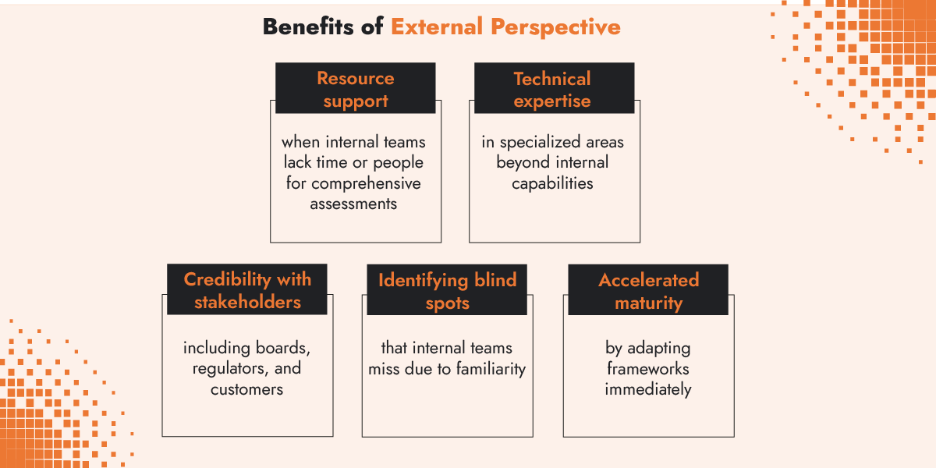
External advisors bring critical value through:
- Resource support when internal teams lack time or people for comprehensive assessments
- Technical expertise in specialized areas beyond internal capabilities
- Credibility with stakeholders including boards, regulators, and customers
- Identifying blind spots that internal teams miss due to familiarity
In today's environment of increasing personal liability and regulatory scrutiny, external validation provides defensible evidence of due diligence. This is especially critical when board members and officers face potential criminal penalties for governance failures.
The key is using external support strategically—not as a replacement for internal ownership, but as a catalyst for building more robust cybersecurity governance. Whether validating compliance efforts, assessing cyber and technology risk, or adapting a governance framework, external perspectives help organizations build resilient cybersecurity programs while maintaining clear internal accountability.
How C-Risk helps you build smarter cybersecurity governance
C-Risk enables organizations to make strategic, data-driven cyber risk decisions by combining expert advisory, quantitative methods, and purpose-built technology.
We help you :
- Build a data-driven cyber risk management program
- Implement FAIR™ risk quantification
- Operationalize cyber risk management with the SAFE platform
- Adapt your cybersecurity governance model to your regulatory and business context
- Enhance executive and board-level cyber risk reporting